 Art
Art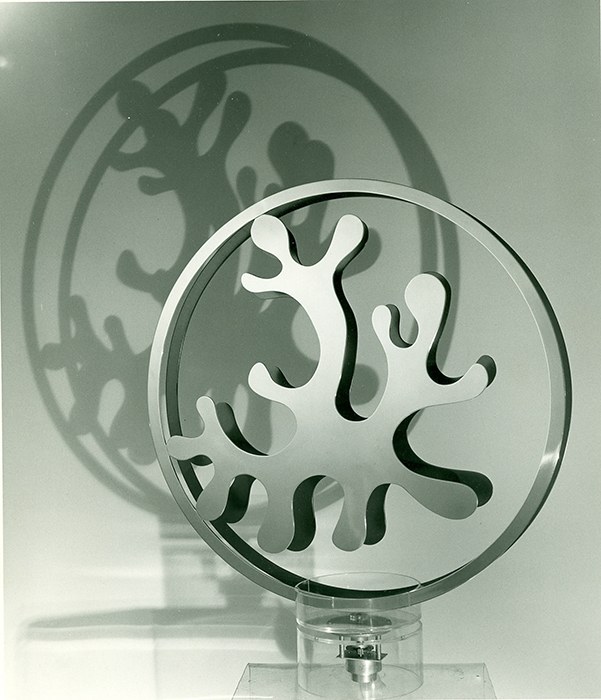
'Bacchanal' by Phyllis Mark,1968. Image: Uploaded by Ira S. Mark, TTEE, Phyllis Mark Revocable Trust, the trust of the artist's estate. · CC BY-SA 4.0 · Wikimedia Commons, accessed 2026-08-04
Kinetic Art is the umbrella term for sculpture and constructed art that incorporates actual or implied movement — works that are motorized, wind- or hand-activated, dependent on the viewer's own motion past them, or built to create optical vibration that reads as movement even though nothing physically moves. Though the idea has roots in the early twentieth century, it crystallized as a named international movement with the landmark 1955 exhibition Le Mouvement at Galerie Denise René in Paris, which brought together Victor Vasarely, Jean Tinguely, Jesús Rafael Soto, Yaacov Agam, and others under a shared banner, accompanied by Vasarely's "Yellow Manifesto."
The resulting works range widely in method. Alexander Calder, working since the early 1930s, had already invented the hanging mobile — abstract shapes balanced on wire arms that shift and rotate on air currents, a form Marcel Duchamp named. Jean Tinguely built noisy, absurdist motorized machines, culminating in Homage to New York (1960), a sculpture in the MoMA garden engineered to destroy itself in front of an audience. Jesús Rafael Soto and Yaacov Agam built optical, relief-based works that appear to change entirely as a viewer walks past them, while Nicolas Schöffer's CYSP 1 (1956) used electronic sensors to move autonomously in response to light and sound, making it one of the first cybernetic sculptures.
Kinetic Art traces its intellectual roots to the Constructivists — Naum Gabo and Antoine Pevsner's 1920 Realistic Manifesto had already called for "kinetic rhythm" as a basic artistic element — and to Dada, particularly Marcel Duchamp's spinning Rotoreliefs and readymade Bicycle Wheel. It rebelled against the static, permanently fixed art object, arguing that motion, chance, and the viewer's own presence in space should be part of the artwork rather than external to it. The movement matters because it dissolved the boundary between sculpture, engineering, and spectacle, and because it insisted that meaning in art could emerge from time and change rather than a single fixed image — an idea that fed directly into later technology-based and interactive art.
What defines Kinetic Art
Literal, physical motion
Many works are motorized, wind-driven, or hand-activated, incorporating gears, motors, or suspension systems so the sculpture genuinely changes position over time.
Viewer-activated change
Some pieces remain still until a viewer moves around or past them, at which point relief surfaces, layered elements, or moiré patterns appear to shift and transform.
Optical vibration without movement
Certain works use dense repeated lines, contrasting colors, or layered grids to trick the eye into perceiving motion or flicker on an entirely static surface.
Industrial materials and construction
Metal rods, wire, motors, glass, and machined parts replace traditional sculptural materials like bronze or marble, often borrowing directly from engineering and industrial design.
Chance and unpredictability
Mobiles and wind- or motor-driven pieces are frequently designed so their exact configuration at any moment cannot be fully predicted or repeated.
Collaboration with science and technology
Several artists incorporated electronics, sensors, or programmed sequences, treating kinetic sculpture as a meeting point between art and contemporary technology.
History
Kinetic Art's roots reach back to the 1920s, when Constructivists Naum Gabo and Antoine Pevsner called for motion as a basic sculptural element in their 1920 Realistic Manifesto, and to Marcel Duchamp's early experiments with rotating discs and the readymade Bicycle Wheel (1913). Alexander Calder, encouraged by a 1930 visit to Piet Mondrian's studio, began building suspended, air-activated abstract sculptures in the early 1930s that Duchamp christened "mobiles" — arguably the movement's first mature works, decades before it had a name.
The movement gained a collective identity in 1955, when the Paris dealer Denise René staged Le Mouvement, an exhibition placing established figures Alexander Calder and Marcel Duchamp alongside younger artists — Jean Tinguely, Jesús Rafael Soto, Yaacov Agam, Pol Bury — and Victor Vasarely, whose accompanying "Yellow Manifesto" argued for a shared kinetic and optical program. Through the late 1950s and 1960s, the tendency spread internationally: Nicolas Schöffer built early cybernetic, sensor-driven sculptures; the Zero group in Germany and GRAV (Groupe de Recherche d'Art Visuel) in Paris pursued related light- and motion-based work; and museums staged large survey exhibitions that linked kinetic work to the closely related, primarily two-dimensional tendency of Op Art.
Jean Tinguely's Homage to New York (1960), a self-destructing machine performed in MoMA's sculpture garden, became one of the movement's most famous public spectacles, embodying its embrace of chance, mechanism, and impermanence. Through the 1960s and into the 1970s, kinetic ideas fed into public sculpture commissions worldwide, with artists like Soto and Agam producing large architectural and civic installations. As a distinctly branded movement, Kinetic Art's momentum slowed by the mid-1970s as artists absorbed its ideas into broader practices, including installation, light art, and early technology-based art, but motorized and viewer-activated sculpture has remained a continuous thread in contemporary art ever since.
Key works
| Work | Artist | Year | Why it matters |
|---|---|---|---|
| Lobster Trap and Fish Tail | Alexander Calder | 1939 | An early hanging mobile that helped establish air-activated suspended sculpture as a serious artistic form, decades before Kinetic Art was named. |
| CYSP 1 | Nicolas Schöffer | 1956 | One of the first cybernetic sculptures, using electronic sensors to move autonomously in response to light and sound. |
| Homage to New York | Jean Tinguely | 1960 | A motorized sculpture built to destroy itself in a public performance in MoMA's sculpture garden. |
| Double Metamorphosis II | Yaacov Agam | 1964 | A relief painting whose image transforms entirely depending on the viewer's position and angle of approach. |
| Vibración | Jesús Rafael Soto | 1965 | One of Soto's recurring series of optical reliefs designed to appear to shimmer and vibrate as a viewer moves past. |
How to make art in this style
Working in a Kinetic Art Style
Palette: Color choices vary by approach: mobiles and machine-based sculpture often stay close to natural material colors — raw metal, black, white — while optical and relief-based kinetic work favors high-contrast combinations, especially black and white paired with a single saturated primary, to maximize the sense of vibration or shift.
Composition: Design for more than one viewing angle or moment. If working sculpturally, plan how the piece will look from multiple positions and how its parts relate to each other in motion, not just in a single frozen state. If working with a relief or painted surface, build in repeated lines, layered strips, or shifting grids that change as the viewer's position changes.
Technique: For a motion-based piece, balance is critical — mobiles rely on precise weight distribution so elements move freely on air currents alone. For motorized or mechanized work, keep the mechanism visible or at least implied, since part of the effect depends on the viewer sensing how the motion is produced. For optical, static work, use precise, repeatable geometry — straight lines, regular curves, consistent spacing — since the illusion of movement depends on exactness, not gesture.
Subjects: Kinetic work is almost always abstract and non-representational; the subject is motion, perception, and the passage of time itself rather than any depicted scene or figure.
Process: Test physical pieces in the actual conditions where they'll be seen — air currents, foot traffic, lighting — since kinetic work only fully exists in interaction with its real environment.
Legacy
Kinetic Art established motion, chance, and viewer participation as legitimate sculptural concerns, breaking decisively with the idea that a sculpture must be a single, permanently fixed form. That premise fed directly into later light art, sound art, and interactive installation, and its collaboration with engineers and technologists anticipated the far closer art-technology partnerships of subsequent decades, including early computer and video art.
Public commissions by Calder, Soto, Agam, and their successors placed genuinely kinetic and viewer-responsive sculpture in plazas, airports, and civic buildings worldwide, making the movement one of the most publicly visible strands of postwar abstraction — many people have stood beneath a mobile or walked past a vibrating optical relief without knowing the movement's name. Tinguely's self-destructing machines prefigured later art that incorporates entropy, malfunction, and impermanence as intentional content.
Today, kinetic principles underpin large parts of contemporary art involving motors, sensors, and viewer interaction, from gallery installation to large-scale public sculpture and museum-commissioned interactive environments. The movement's core idea — that an artwork can be genuinely, unrepeatably different from one moment to the next — remains one of postwar art's most durable contributions to how sculpture is made and experienced.
Frequently asked questions
What is Kinetic Art?
Kinetic Art is sculpture and constructed art built around real or implied motion, including motorized machines, wind-activated mobiles, viewer-triggered relief works, and static pieces that create an optical illusion of movement.
What is the difference between Kinetic Art and Op Art?
Kinetic Art generally involves actual physical movement or is activated by the viewer's own motion through space, while Op Art is typically flat, painted, and static, using color and pattern alone to trick the eye into perceiving movement or vibration.
Who invented the mobile?
Alexander Calder began building suspended, air-activated abstract sculptures in the early 1930s; the term "mobile" for these works is credited to his friend and fellow artist Marcel Duchamp.
When did Kinetic Art become a named movement?
Kinetic Art gained its collective identity with the 1955 exhibition Le Mouvement at Galerie Denise René in Paris, which placed established figures Alexander Calder and Marcel Duchamp alongside younger artists such as Jean Tinguely, Jesús Rafael Soto, Yaacov Agam, and Pol Bury under a shared program of motion-based art.
What materials do Kinetic artists use?
Kinetic artists typically work with metal, wire, motors, glass, and other industrial or mechanical components, often borrowing techniques and materials directly from engineering.