 Art
Art
Azopardo River of Rockwell Kent 1922. Image: Rockwell Kent · Public domain · Wikimedia Commons, accessed 2026-08-04
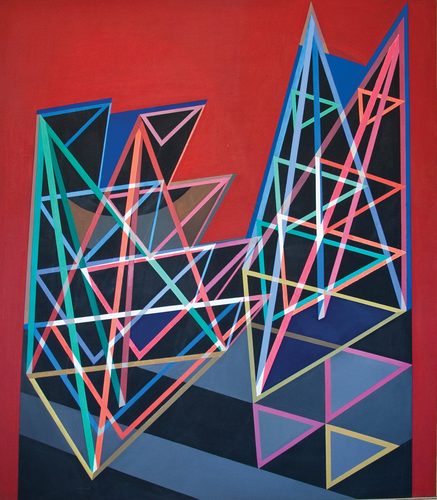
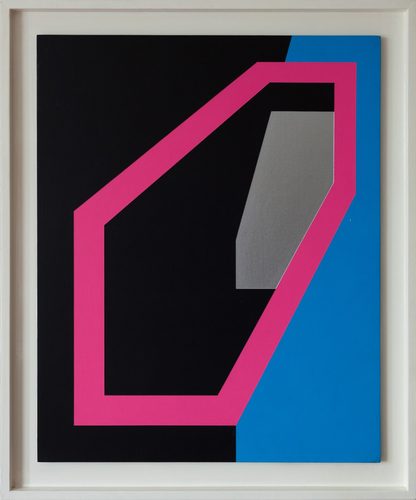
Hard-Edge Painting names a mode of geometric abstraction defined by flat, evenly applied areas of color meeting at crisp, sharply delineated boundaries, with no blending, shading, or visible brushstroke softening the transition between shapes. Where much abstract painting of the 1940s and 1950s prized gesture, texture, and the visible trace of the artist's hand, Hard-Edge painters sought the opposite: an impersonal, almost industrial precision in which color and shape alone carried the composition's full expressive weight.
The term was coined in 1959 by critic Jules Langsner to describe the work of a group of Los Angeles abstractionists — Lorser Feitelson, Karl Benjamin, John McLaughlin, and Frederick Hammersley — who were shown together that year in the exhibition "Four Abstract Classicists." Their paintings used large, flat planes of unmodulated color arranged in simple geometric relationships, owing a debt to the earlier hard-edged geometric abstraction of Piet Mondrian and the color theory of the Bauhaus. The label was soon extended eastward to describe related developments in New York, particularly the taped, precisely bounded color paintings of Ellsworth Kelly, Kenneth Noland's concentric target and chevron paintings, and Frank Stella's austere, symmetrical "Black Paintings" and subsequent shaped canvases.
Hard-Edge Painting rebelled against the emotional, autobiographical claims of Abstract Expressionism, insisting that a painting could achieve intensity and presence through color relationships and geometric clarity alone, without any reference to the artist's psychological state. It shared ground with Color Field Painting in its use of large, flat areas of color, but distinguished itself by favoring taped, ruler-straight boundaries over Color Field's soft, stained, or bleeding edges.
The style matters because it provided a crucial bridge between the painterly abstraction of the 1950s and the industrially fabricated, object-based reduction of Minimalism in the 1960s. Its insistence that a painting's edge, shape, and color relationships could themselves be the entire content of the work directly anticipated Minimalism's rejection of illusion and gesture, and its practitioners — especially Ellsworth Kelly and Frank Stella — remained central figures in American abstraction for decades after the label itself faded from use.
What defines Hard-Edge Painting
Flat, unmodulated color
Color fields are applied with perfectly even, uninflected surfaces, free of visible brushstroke, blending, or tonal shading. Each shape reads as a single, uniform block of color rather than a modulated surface.
Crisp, precise boundaries
Edges between color areas are sharply defined, typically achieved with masking tape or careful measurement, producing a clean line rather than a soft transition. This precision is the technique's defining feature and its namesake.
Geometric, simplified shapes
Compositions rely on basic geometric forms — circles, chevrons, stripes, rectangles — arranged in clear, often symmetrical relationships. Complexity comes from color interaction and proportion rather than from intricate drawing.
Impersonal, industrial finish
The absence of visible gesture gives the work a cool, machine-like surface quality, deliberately withholding evidence of the artist's hand. Some practitioners used commercial paints and spray techniques to reinforce this impersonal finish.
Optical color relationships
Adjacent colors are chosen for their interactive effects — vibration, advance, and recession — so that the picture's energy comes from how hues sit against one another rather than from represented subject matter. This connects the style closely to contemporaneous Op Art experiments.
Shaped and structured canvases
Some practitioners extended hard-edge logic to the canvas itself, cutting the support into notched, angled, or irregular shapes that echoed the painted composition. Frank Stella's shaped canvases of the mid-1960s pushed this idea furthest, making the literal edge of the object as sharp as the painted edges within it.
History
Hard-Edge Painting emerged on two fronts in the United States in the late 1950s. In Los Angeles, painters Lorser Feitelson, Karl Benjamin, John McLaughlin, and Frederick Hammersley had independently been developing geometric abstraction built from flat color and sharp boundaries through the 1950s, work that art critic Jules Langsner named in the catalog for the 1959 exhibition "Four Abstract Classicists" at the Los Angeles County Museum of Art, coining the term "hard-edge" to distinguish their precise geometry from the gestural abstraction then dominant on the East Coast.
In New York, a parallel development was underway independent of the California group. Ellsworth Kelly, who had spent years in Paris absorbing the flat color planes of artists like Jean Arp, returned to New York in 1954 making paintings of large, simplified color shapes with taped, exact edges. Kenneth Noland, working in Washington, D.C., developed his own hard-edge vocabulary of concentric circles, chevrons, and stripes using thinned acrylic paint on unprimed canvas. Frank Stella's severe, symmetrical "Black Paintings," first shown in 1959, pushed the logic of the flat, edge-defined surface to an extreme, an ethos Stella later distilled in his statement that "what you see is what you see."
The critic Clement Greenberg's promotion of "post-painterly abstraction," the title of a 1964 exhibition he organized, further consolidated Hard-Edge painters alongside Color Field artists as a recognized alternative to Abstract Expressionism. By the mid-1960s, the style's emphasis on flatness, literalism, and impersonal precision had become a direct influence on the emerging Minimalist sculptors, who extended its logic from the painted canvas into fabricated three-dimensional objects. As a distinct label, "Hard-Edge Painting" faded from critical use by the early 1970s, even as key practitioners such as Kelly and Stella continued working within its core principles for the rest of their long careers.
Key works
| Work | Artist | Year | Why it matters |
|---|---|---|---|
| Colors for a Large Wall | Ellsworth Kelly | 1951 | A grid of sixty-four monochrome panels in varied hues, an early statement of Kelly's flat, edge-defined color logic. |
| Die Fahne Hoch! | Frank Stella | 1959 | A symmetrical composition of black stripes separated by thin raw canvas, part of the austere Black Paintings series that launched Stella's career. |
| Beginning | Kenneth Noland | 1958 | A concentric target-like composition of thinned, stained color rings that established Noland's signature circular format. |
| Empress of India | Frank Stella | 1965 | A shaped canvas built from four interlocking chevron forms, extending hard-edge logic from painted surface to the literal shape of the support. |
How to make art in this style
Working in a Hard-Edge Painting Style
Plan the composition before touching paint. Because the style depends on exact geometry, work out shapes, proportions, and color relationships in preliminary drawings or digital mockups first. Spontaneous improvisation with the brush works against the method's core discipline.
Mask every edge. Use quality painter's tape or precisely cut stencils to define every boundary between color areas before applying paint, and burnish the tape edge firmly to prevent bleed. Remove tape only once paint is fully dry to keep lines razor-sharp.
Apply color in flat, even coats. Use a roller, sprayer, or a wide flat brush with thinned, consistent paint to avoid visible brushstrokes or tonal variation within a single shape. Multiple thin coats generally produce a more even surface than one thick application.
Choose a limited, high-value-contrast palette. Select a small number of saturated hues and consider how they interact optically — complementary pairs will vibrate at their shared edge, while analogous colors will sit more calmly together. Test swatches side by side before committing to the full composition.
Favor basic geometric vocabulary. Circles, chevrons, stripes, and rectangles arranged in symmetrical or serial relationships are the style's core forms; let proportion, scale, and color do the compositional work rather than intricate shapes.
Consider the canvas edge itself. For an advanced approach, cut or construct the support into a shape that echoes the internal composition, extending the hard edge from the painted surface to the physical object.
Legacy
Hard-Edge Painting's insistence on flatness, precision, and the elimination of gesture fed directly into Minimalism, whose sculptors took the hard edge's logic of literalism — what you see is exactly what is there — and extended it from canvas into fabricated three-dimensional objects. The style's emphasis on color relationships without illusionistic depth also kept it in close dialogue with Op Art and later Color Field developments, and its taped, exacting technique became a standard studio method still taught in painting programs today. Frank Stella's move from flat hard-edge canvases into shaped and later fully three-dimensional relief work demonstrated how far the style's core logic could be pushed, influencing subsequent generations of artists working at the boundary between painting and sculpture. Ellsworth Kelly's reduction of painting to pure color and shape remains a persistent reference point in contemporary abstraction, graphic design, and architecture, where his crisp forms are frequently cited for their clarity and economy. The style's legacy is visible wherever contemporary painters and designers use flat, saturated color fields with exact, mechanical edges — corporate branding, geometric mural painting, and much digital and vector-based art all descend, whether consciously or not, from the visual vocabulary Hard-Edge painters established in the late 1950s and 1960s.
Frequently asked questions
What is Hard-Edge Painting?
Hard-Edge Painting is a style of geometric abstraction defined by flat, evenly applied color shapes meeting at crisp, precise boundaries, with no blending or visible brushwork softening the transitions between colors.
Who coined the term "hard-edge"?
Critic Jules Langsner coined the term in 1959 for the catalog of "Four Abstract Classicists," an exhibition of Los Angeles painters Lorser Feitelson, Karl Benjamin, John McLaughlin, and Frederick Hammersley.
What is the difference between Hard-Edge Painting and Color Field Painting?
Both use large, flat areas of color, but Hard-Edge Painting favors sharp, taped, ruler-precise boundaries between shapes, while Color Field Painting more often uses soaked, stained, or soft-edged color that bleeds into the canvas.
How does Hard-Edge Painting relate to Minimalism?
Hard-Edge Painting's emphasis on flatness, literalism, and the elimination of gesture directly influenced Minimalist sculptors, who extended its logic of "what you see is what you see" from painted canvas into fabricated three-dimensional objects.
Is Hard-Edge Painting the same as geometric abstraction?
Hard-Edge Painting is a specific strain of geometric abstraction distinguished by its flat, unmodulated color and razor-sharp edges; earlier geometric abstraction, such as Kandinsky's Bauhaus-era work, could include shading, texture, or looser boundaries that Hard-Edge Painting deliberately excluded.