 Art
Art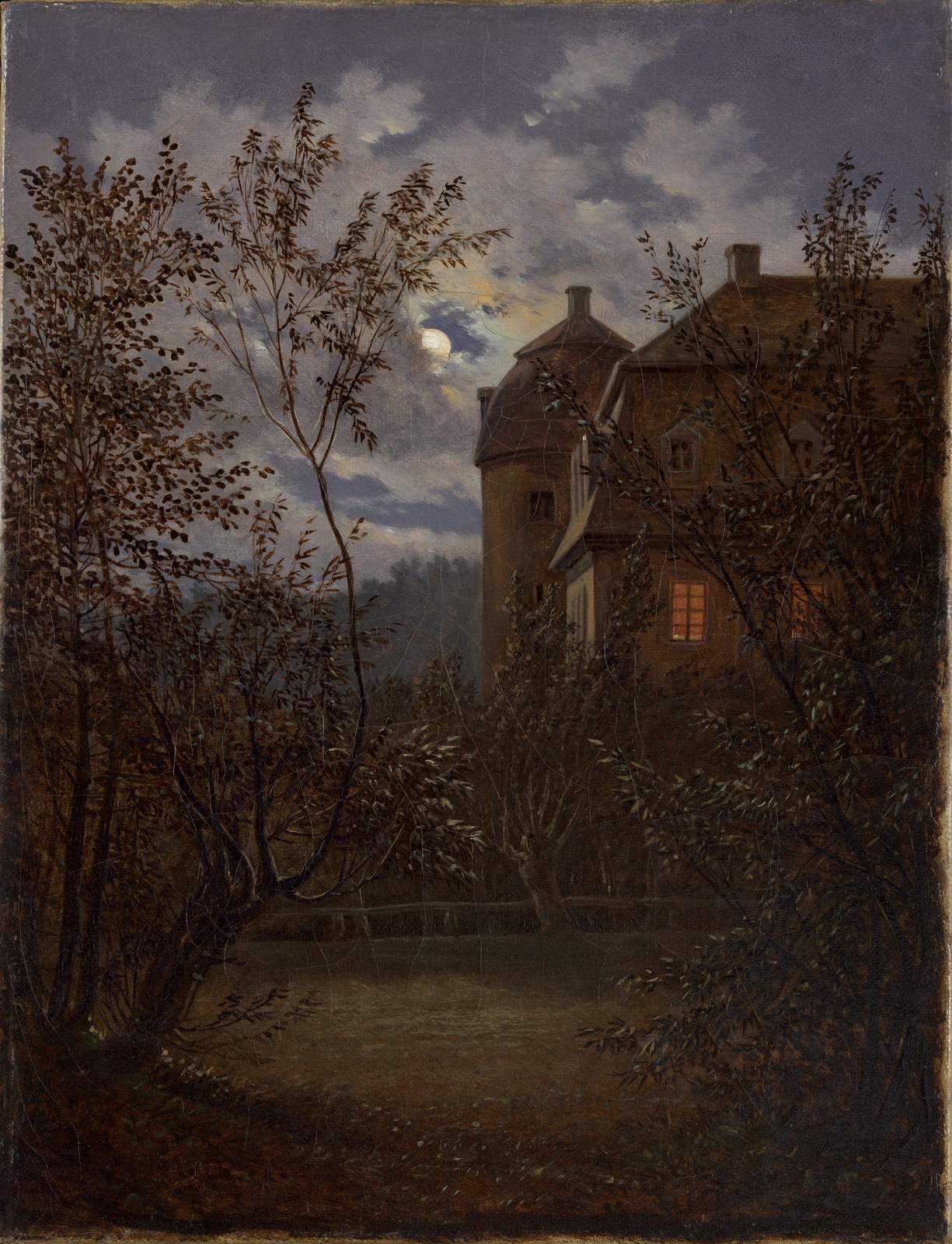
Schloss Milkel in Moonlight. Image: Carl Gustav Carus · Public domain · Wikimedia Commons, accessed 2026-08-04
Romanticism emerged around 1800 as a broad, international reaction against Neoclassicism's rationalism and restraint, prizing instead intense emotion, imagination, and the individual experience of the artist. Where Neoclassical painters looked to ancient Rome for models of civic order, Romantic artists looked inward, to dreams, passion, and psychological extremity, and outward, to nature at its most overwhelming — storms, mountains, ruins, and the vast open sea.
The movement had no single unified style; it was less a set of formal rules than a shared sensibility that valued feeling over reason, the individual over the institution, and the sublime — that mixture of awe and terror provoked by overwhelming scale or power — over calm beauty. This sensibility took different visual forms in different hands. Eugène Delacroix built compositions from swirling movement and intense, often exotic color, extending Baroque drama into contemporary and literary subjects. Théodore Géricault turned a real, scandalous shipwreck into a monumental tragedy in The Raft of the Medusa, breaking with heroic conventions of history painting. Caspar David Friedrich, by contrast, painted still, contemplative scenes of solitary figures dwarfed by vast landscapes, using nature to stage quiet, almost religious introspection. J.M.W. Turner dissolved landscape and seascape into near-abstract fields of light and atmosphere, chasing sensation over topographical accuracy. Francisco Goya turned Romantic intensity toward political horror and psychological nightmare, particularly in his late work.
Romanticism also carried a political charge. It coincided with the French Revolution, the Napoleonic Wars, and a wave of nationalist movements across Europe, and Romantic artists frequently treated contemporary political events, historical trauma, and national folklore as subjects worthy of the same seriousness once reserved for classical mythology.
Romanticism matters because it permanently expanded what art was understood to be for. After Romanticism, subjective feeling, individual vision, and the artist's inner life became legitimate, even central, subjects — a shift that underwrites virtually all later modern art's interest in personal expression, and that still shapes how contemporary audiences expect art to communicate emotion rather than only instruct or decorate.
What defines Romanticism
Emphasis on intense emotion
Romantic art foregrounds feeling — awe, terror, grief, passion, longing — treating emotional truth as at least as important as accurate representation. Figures and landscapes alike are charged with mood rather than presented neutrally.
The sublime in nature
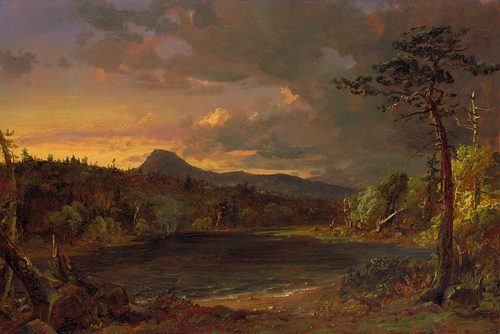
Painters depicted nature at overwhelming scale — storms, cliffs, glaciers, vast skies — to provoke the sublime, a combination of awe and terror at forces beyond human control. Human figures are often small against these landscapes, emphasizing vulnerability.
Dramatic, loose brushwork and color
Compared to Neoclassicism's crisp line, Romantic painting often favors visible, energetic brushwork and rich, sometimes exotic color, where paint handling itself conveys emotional intensity.
Interest in the exotic, medieval, and folkloric
Romantic artists frequently turned to distant lands, the Middle Ages, and national folklore rather than classical antiquity, reflecting a fascination with cultural difference, historical imagination, and emerging nationalism.
The solitary, expressive individual
Romantic art often centers a single figure in contemplation or crisis — a wanderer, a castaway, a visionary — reflecting the movement's investment in individual subjective experience over collective or institutional ideals.
Contemporary and political subject matter
Rather than restricting serious painting to ancient history, Romantic artists depicted current events — revolutions, shipwrecks, wars — with the same monumental gravity once reserved for classical or biblical scenes.
History
Romanticism developed across Europe from roughly 1800 to 1850, growing out of late eighteenth-century currents in literature and philosophy — including the Sturm und Drang movement in Germany and the aesthetic theory of the sublime articulated by philosopher Edmund Burke — and accelerated by the emotional and political upheaval of the French Revolution and Napoleonic Wars.
In Spain, Francisco Goya's late work, including his unflinching depictions of the Peninsular War's atrocities, anticipated Romanticism's turn toward psychological extremity and political horror even before the movement was clearly named. In Germany, Caspar David Friedrich developed a contemplative, spiritually inflected landscape painting centered on solitary figures confronting nature's vastness. In France, Théodore Géricault's 1819 The Raft of the Medusa, based on a recent and politically explosive shipwreck, announced a new generation's ambitions, and Eugène Delacroix carried the style forward through the 1820s and 1830s with dynamic color and dramatic subjects, including his 1830 Liberty Leading the People, responding directly to that year's July Revolution.
In Britain, J.M.W. Turner pushed landscape and marine painting toward increasingly atmospheric, near-abstract effects of light and weather over his long career, while a parallel Romantic sensibility shaped English poetry and, somewhat differently, the Gothic Revival in architecture and design.
Romanticism was never a single organized school with manifestos and group exhibitions in the way some later movements were; it spread through shared sensibility, personal networks, and parallel developments across national art scenes, closely intertwined with Romantic literature and music of the same decades.
By mid-century, Romanticism's dominance faded as Realism, led by Gustave Courbet, rejected its idealized emotion and imaginative subject matter in favor of unvarnished contemporary life, though Romantic sensibility persisted well beyond 1850 in Symbolism and various national revival movements.
Key works
| Work | Artist | Year | Why it matters |
|---|---|---|---|
| Liberty Leading the People | Eugène Delacroix | 1830 | An allegorical revolutionary scene fusing political immediacy with Romantic dynamism and color. |
| The Raft of the Medusa | Théodore Géricault | 1819 | Based on a real shipwreck scandal, it turned contemporary disaster into monumental tragedy. |
| Wanderer above the Sea of Fog | Caspar David Friedrich | 1818 | A solitary figure confronting sublime nature became an emblem of Romantic introspection. |
| The Third of May 1808 | Francisco Goya | 1814 | An unflinching depiction of wartime execution that broke with heroic battle-painting conventions. |
| The Fighting Temeraire | J.M.W. Turner | 1839 | Its atmospheric dissolution of form captures Romantic nostalgia for a vanishing age of sail. |
How to make art in this style
Working in a Romantic Style
Palette: Use dramatic, sometimes exotic color for narrative subjects — deep reds, golds, stormy grays — or, for landscapes, atmospheric, blended tones that shift with weather and light, from cool misty blues to fiery sunset oranges. Avoid the flat, controlled color of Neoclassicism in favor of mood-driven, sometimes unstable hues.
Composition: Build scenes around dynamic diagonals, turbulent skies, or a single small figure set against a vast landscape to evoke the sublime. For narrative or history subjects, favor dramatic, off-balance arrangements over Neoclassical symmetry, letting the composition itself feel charged with instability or momentum.
Brushwork and technique: Let brushwork carry emotional weight — loose, energetic strokes for storms and drama, softer atmospheric blending for contemplative landscapes. Layering thin veils of color to dissolve form into light and weather suits atmospheric effects; broken, vigorous color handling suits more narrative drama.
Subjects: Choose subjects with genuine emotional or historical weight — a natural disaster, a solitary confrontation with the wilderness, a moment of political upheaval, a scene from national history or folklore. A single figure gazing into a vast landscape is a reliable Romantic formula, as is a crowd caught in a moment of collective crisis or triumph.
Mood: Prioritize atmosphere and feeling over documentary accuracy throughout; Romantic conviction depends on the viewer sensing the artist's own emotional investment in the scene, not on precise topographical or historical correctness.
Legacy
Romanticism's core conviction — that art should express subjective emotion and individual vision rather than only serve institutional or didactic purposes — became a foundational assumption of modern art, underwriting movements from Symbolism and Expressionism to Abstract Expressionism, all of which prioritized inner experience over external convention in their own ways.
The sublime landscape tradition Romanticism developed, particularly through Turner and Friedrich, shaped later landscape painting and photography's fascination with nature's overwhelming scale, and continues to inform how film and photography frame dramatic weather, remote wilderness, and human smallness against vast terrain. Turner's dissolution of form into atmosphere and light is frequently cited as an anticipation of Impressionism and even abstraction.
Romanticism's political dimension — using art to dramatize revolution, national struggle, and historical trauma — also established a template still visible in contemporary photojournalism and history painting's occasional revivals, wherever an artist treats a real, recent event with the emotional weight once reserved for myth. More broadly, the Romantic image of the solitary, tormented, visionary artist still shapes popular ideas of what an artist is and does.
Frequently asked questions
What is Romanticism in art?
Romanticism is an early nineteenth-century movement that prized intense emotion, individual imagination, and the awe-inspiring power of nature over the rational restraint of Neoclassicism. It spanned painting, literature, and music across Europe.
What's the difference between Romanticism and Neoclassicism?
Neoclassicism values reason, restraint, and clear classical form, while Romanticism values emotion, imagination, and dramatic individual experience, often set against turbulent nature or contemporary political events rather than ancient history.
Who are the key Romantic painters?
Eugène Delacroix, Théodore Géricault, J.M.W. Turner, Caspar David Friedrich, and Francisco Goya are among the movement's defining figures, each developing a distinct approach to Romantic emotion and drama.
What is the sublime in Romantic art?
The sublime refers to an aesthetic experience combining awe and terror, typically evoked by nature at overwhelming scale — storms, mountains, the open sea. Romantic painters used the sublime to suggest human vulnerability before forces beyond control.
When did Romanticism take place?
Romanticism flourished roughly from 1800 to 1850, though its roots reach back into late eighteenth-century literature and philosophy, and its emotional sensibility persisted in later movements like Symbolism.