 Art
Art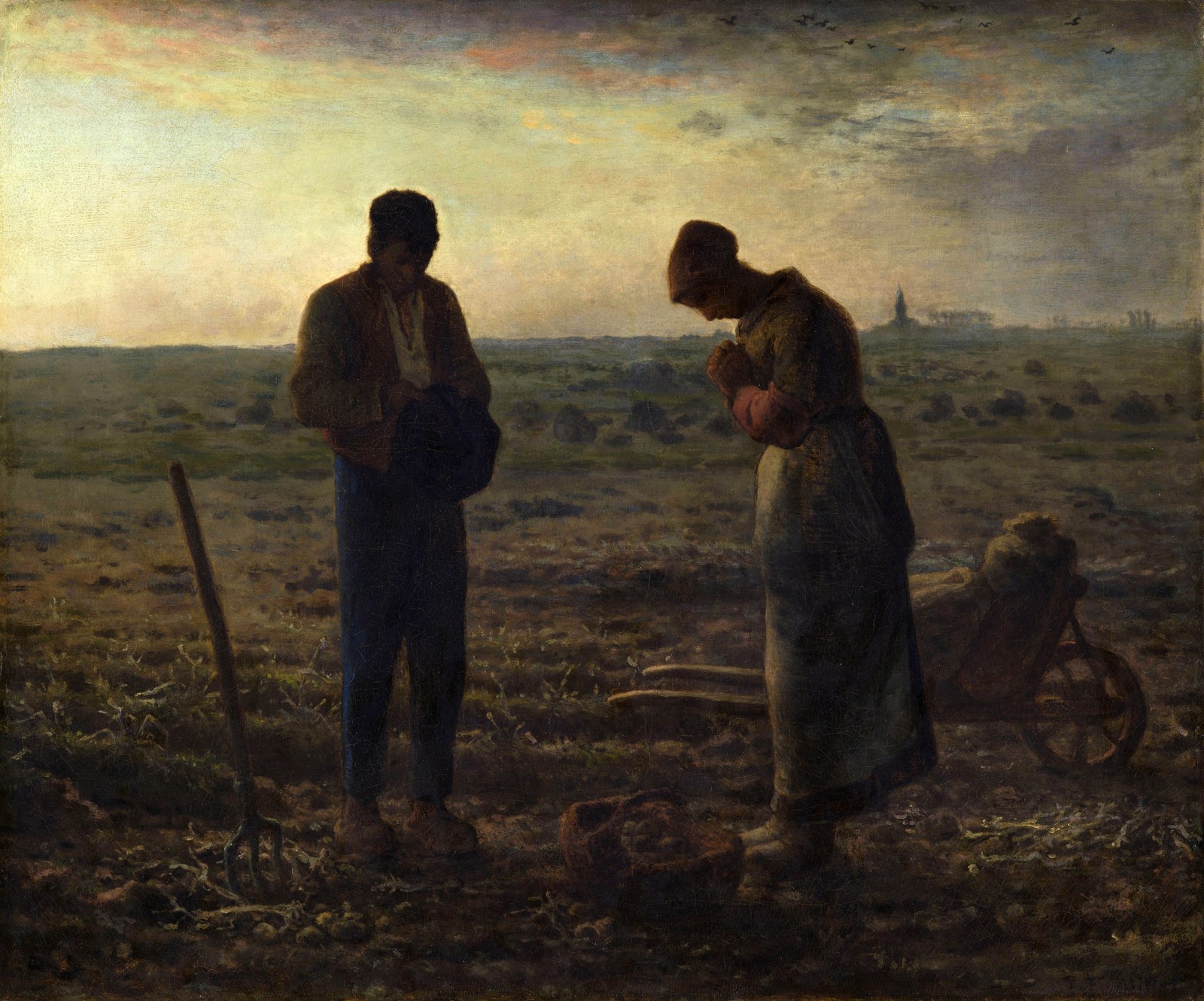
French: L'Angélus The Angelus. Image: Jean-François Millet · Public domain · Wikimedia Commons, accessed 2026-08-04
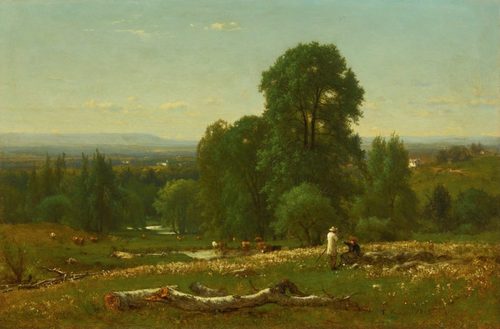
The Barbizon School takes its name from the village of Barbizon on the edge of the Forest of Fontainebleau, southeast of Paris, where a loose community of painters gathered from the 1830s through the 1870s to work directly from the surrounding countryside. Rather than composing idealized, classical landscapes in the studio according to academic formula, these artists set up easels outdoors, observed actual light and weather, and painted rural laborers, forest interiors, and modest farmland with unusual directness and sympathy.
The movement's paintings are typically modest in scale and subdued in palette—earthy greens, browns, and grays rendered with soft, atmospheric handling rather than crisp academic finish. Trees, fields, and peasant figures at work are treated with the same seriousness previously reserved for historical or mythological subjects. Jean-François Millet's peasants gleaning or resting in the fields carry a quiet, dignified gravity; Théodore Rousseau's oak trees are studied with an intensity that borders on portraiture; Camille Corot's silvery, hazy woodland scenes prioritize mood and atmosphere over topographical precision.
Barbizon painters rebelled against the dominant academic tradition of the French Salon, which favored grand historical, mythological, and religious subjects rendered in polished, idealized detail, with landscape treated as at most a decorative backdrop. They rebelled too against the theatrical grandeur of Romantic landscape painting, favoring instead humble, unglamorous rural reality observed on the spot. Working outdoors, sketching directly from nature even if final canvases were often finished in the studio, they helped establish plein air observation as a legitimate and valuable artistic method rather than a mere preparatory exercise.
The Barbizon School matters as a crucial hinge point in nineteenth-century French painting. It elevated landscape and rural genre subjects to major status, it validated direct observation of light and atmosphere as an artistic end in itself, and it directly prepared the ground for both Realism's unsentimental attention to ordinary life and Impressionism's full commitment to painting outdoors. Several core Impressionists, including Monet and Renoir, studied Barbizon painters closely before developing their own more radical approach to light and brushwork.
What defines Barbizon School
Direct observation of rural landscape
Painters worked from the actual fields, forests, and villages around Barbizon and Fontainebleau, prioritizing observed light, weather, and terrain over invented or idealized classical scenery.
Muted, earthy palette
Colors lean toward soft greens, browns, grays, and warm neutral tones, avoiding the bright, saturated color that would later define Impressionism in favor of tonal harmony and atmospheric unity.
Dignified peasant and rural labor subjects
Farmworkers, shepherds, and gleaners are depicted with quiet seriousness and physical presence, treated as worthy subjects in their own right rather than picturesque staffage.
Soft, atmospheric brushwork
Edges are often gently blurred and forms built through layered, visible but controlled brushwork, creating a hazy, mood-driven atmosphere rather than crisp linear detail.
Modest, intimate scale
Unlike the grand exhibition canvases of academic or Hudson River School painting, Barbizon works are frequently smaller and more contemplative, suited to close, quiet viewing.
Emphasis on light and time of day
Many works focus on specific transient conditions—early morning mist, late afternoon glow, the fading light of dusk—observed and recorded with careful attention.
History
The Barbizon School coalesced through the 1830s as a loose colony of painters began settling in or regularly visiting the village of Barbizon, drawn by the untamed forest of Fontainebleau nearby and its escape from Parisian academic conventions. Théodore Rousseau, repeatedly rejected by the official Salon for landscapes deemed too rough and unidealized, became an early central figure, along with Camille Corot, whose softer, silvery style bridged the earlier Romantic landscape tradition and the new naturalism.
Jean-François Millet joined the community in 1849, bringing an even stronger focus on peasant labor and rural poverty, informed partly by the political upheavals of the 1848 revolutions across Europe. His paintings of gleaners, sowers, and resting laborers gave the movement its most socially charged and, at the time, controversial dimension—some critics read his dignified peasants as implicitly radical statements about class and labor.
Other painters associated with the group, including Charles-François Daubigny, extended the Barbizon approach toward river and water subjects, working increasingly directly outdoors and using a looser, more spontaneous brushwork that anticipated Impressionist technique. Daubigny in particular painted from a small boat-studio on the Oise River, a practice that directly influenced younger painters including Monet.
By the 1870s, the original generation of Barbizon painters was aging or had died, and the movement's innovations had been absorbed and radicalized by Impressionism, which pushed plein air observation and broken color further than any Barbizon painter had attempted. The Barbizon School did not end abruptly so much as feed directly into its successor; many Impressionists explicitly credited Barbizon painters, particularly Corot and Daubigny, as essential predecessors. Today the movement is understood as the essential transitional link between academic Romantic landscape and the full modern embrace of painting light and atmosphere on the spot.
Key works
| Work | Artist | Year | Why it matters |
|---|---|---|---|
| The Gleaners | Jean-François Millet | 1857 | A monumental treatment of three peasant women gathering leftover grain, its dignified realism read by contemporaries as a quietly political statement on rural poverty. |
| The Angelus | Jean-François Millet | 1857 | A hushed image of two peasants pausing in prayer at dusk, later one of the most widely reproduced paintings of the nineteenth century. |
| Souvenir de Mortefontaine | Camille Corot | 1864 | A hazy, silvery lakeside landscape exemplifying Corot's atmospheric, poetic late style. |
How to make art in this style
Painting in the Barbizon Style Today
Palette: Work within a muted, earthy range—olive and sage greens, umber, warm browns, soft grays, and dulled golds. Avoid bright, saturated color; unify the palette so foreground and sky feel part of the same atmospheric envelope, especially in scenes depicting mist, dusk, or overcast weather.
Composition: Favor humble, close-to-home rural subjects over grand vistas—a forest interior, a field at the edge of a village, a river bend. Keep compositions relatively simple and intimate rather than panoramic, with a clear but unforced focal point, often a single tree, figure, or group of figures engaged in quiet labor.
Brushwork and technique: Paint or sketch directly from observed outdoor light where possible, even if you finish the work indoors. Use soft, layered brushwork with gently blurred edges rather than crisp linear definition—build form through tonal transition more than hard contour. Keep detail concentrated where the eye should rest and let peripheral areas dissolve into atmosphere.
Subjects: Choose ordinary rural life—farmworkers gleaning, resting, or tending animals; forest studies of individual trees; quiet river or field scenes at a specific time of day. Treat any human figures with unsentimental dignity: solid, weighted, absorbed in their task rather than posed or picturesque. Let the specific quality of light—morning haze, late-day glow, overcast flatness—be as much the subject as anything depicted within it.
Legacy
The Barbizon School's most direct legacy is Impressionism itself: Monet, Renoir, and their peers studied Corot's and Daubigny's outdoor practice closely, and Impressionism's core method of painting directly from observed light grew out of habits the Barbizon painters had already normalized. Without Barbizon's prior legitimization of landscape and rural genre subjects, the Impressionists' choice of ordinary modern subject matter over history painting would have been a far more radical leap.
The movement's dignified treatment of rural labor, especially in Millet's work, also fed into Realism and later Social Realism, establishing that painting could take working people's lives seriously as subject matter without sentimentality or condescension. Van Gogh, in particular, cited Millet as a formative influence, copying several of his compositions decades later.
Beyond painting, the Barbizon aesthetic—muted, atmospheric, quietly observant of rural landscape and labor—continues to inform how photography, film, and illustration depict pastoral and agrarian subjects, and the movement's practice of working en plein air became a foundational method still taught to landscape painters today. Its example demonstrated that unglamorous, close-to-home subject matter, observed honestly rather than idealized, could carry as much artistic weight as grand historical or mythological themes.
Frequently asked questions
What is the Barbizon School?
The Barbizon School was a group of French landscape and rural genre painters active from roughly 1830 to 1870, based around the village of Barbizon near the Forest of Fontainebleau. They painted rural life and landscape from direct observation rather than academic formula.
Why is it called the Barbizon School?
It is named after Barbizon, the village where many of its painters lived or regularly worked, drawn by its proximity to the Forest of Fontainebleau's varied, unspoiled terrain.
How did the Barbizon School influence Impressionism?
Barbizon painters, especially Corot and Daubigny, normalized painting directly outdoors from observed light and established landscape as a serious independent subject. Younger Impressionists studied and built directly on both practices.
Who were the main Barbizon painters?
Key figures include Théodore Rousseau, Jean-François Millet, Camille Corot, and Charles-François Daubigny, each bringing a somewhat different focus, from Millet's peasant labor to Corot's atmospheric poetry.
What is the difference between Barbizon painting and Realism?
The two overlapped considerably and shared some painters and subjects; Barbizon is generally understood as landscape-centered and atmospheric, while Realism, led by Courbet, was broader in subject and more deliberately confrontational toward academic taste.