 Art
Art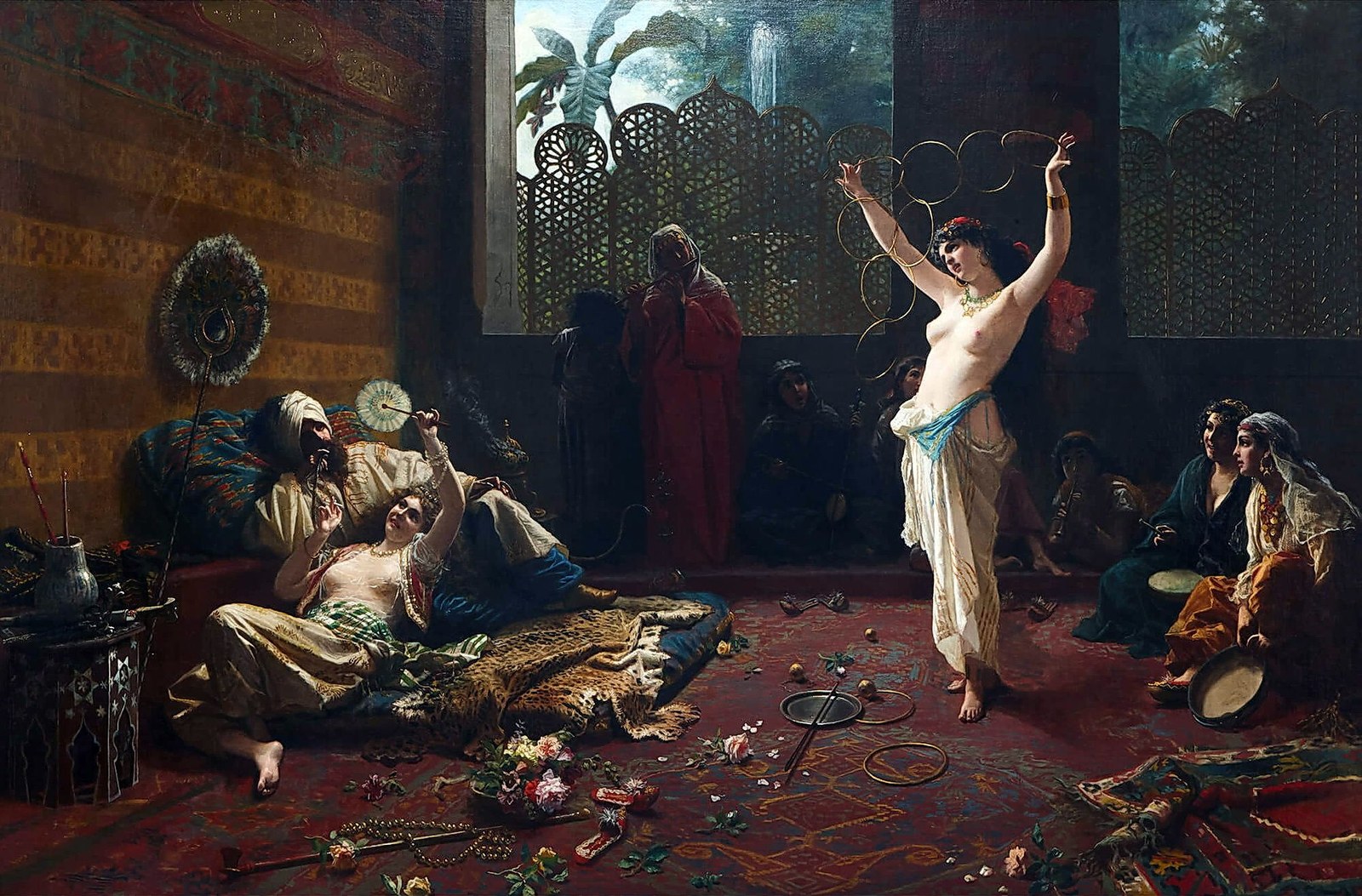
"Une soirée oisive au sérail" by Giacomo Mantegazza. Image: Giacomo Mantegazza · Public domain · Wikimedia Commons, accessed 2026-08-04
Orientalism refers to the depiction of the Middle East, North Africa, and the wider Islamic world by 19th-century European painters, more a shared subject matter than a single style. It ranges from the turbulent, theatrical color of Eugene Delacroix's Romantic canvases to the polished, near-photographic finish of academic painters like Jean-Leon Gerome. What unites the works is a European gaze cast on an imagined East, a composite of Ottoman Turkey, Egypt, the Levant, and North Africa, rendered through travel sketches, studio props, borrowed photographs, and no small amount of invention. British Orientalism developed in parallel, with John Frederick Lewis producing meticulously observed scenes of Cairene domestic life after years of residence in Egypt.
The movement's favorite subjects recur across hundreds of canvases: harem interiors no Western man could actually have entered, slave markets, snake charmers, desert caravans, mosque courtyards, and bazaars thick with textiles and light. Painters combined genuine ethnographic curiosity, carefully studied architecture, costume, and ornament, with pure fantasy, especially in scenes of women's private quarters, which were staged from European studio models and imagination rather than observation.
Orientalist painting rebelled against nothing so much as the limits of the European imagination itself: it offered Salon audiences a sanctioned outlet for sensuality, violence, and spectacle that history painting's classical subjects no longer supplied, while riding a wave of colonial expansion, France's conquest of Algeria began in 1830, and new travel access to the Ottoman world. Its importance is double-edged. Technically, it produced some of the most accomplished academic painting of the century, prized for exacting detail and rich color. Historically, it stands as a primary visual record of how Europe pictured, and, per Edward Said's influential 1978 critique, constructed and dominated, the Islamic world it painted, a tension that still shapes how these images are read today. The genre spanned every rank of the Salon system, from small studio sketches to monumental exhibition canvases, making it one of the most commercially successful genres of the century. Orientalism remains essential to understanding both 19th-century academic painting at its technical peak and the colonial-era imagination that produced it.
What defines Orientalism
Meticulous, near-photographic detail
Academic Orientalists like Gerome built compositions from studio props, travel photographs, and objects collected on their journeys, rendering tile work, weapons, and costume with exacting precision. This documentary finish gave invented scenes an unearned appearance of ethnographic truth.
Sun-drenched, saturated color
Warm golds, deep blues, and sunbaked ochres dominate, often set against sharp Mediterranean or desert light. Strong contrasts of shadow and glare stand in for the heat and intensity Europeans associated with the region.
The imagined harem
Interior scenes of secluded women, bathing, reclining, or attended by servants, recur constantly despite being spaces no Western painter could access. These images were staged fantasies built from European studio models, not observed reality.
Marketplace and desert spectacle
Slave markets, snake charmers, bazaars, and camel caravans supplied dramatic, exotic incident that Salon audiences found thrilling, doubling as an implicit picture of a society Europeans viewed as both alluring and backward.
Architectural precision
Mosques, courtyards, and tiled interiors are rendered with an almost archaeological exactness, feeding a Western visual vocabulary for Islamic architecture that persisted well into the 20th century.
Romantic versus academic modes
Delacroix's Orientalism favors loose, dramatic brushwork and emotional color inherited from Romanticism, while later academic painters like Gerome favor tight, polished realism, two visibly different techniques united by the same fascination with the East.
History
Orientalism's roots trace to Napoleon's 1798 Egyptian campaign, which brought back scholarly documentation of Egyptian antiquity and sparked a broader European fascination with the ancient and contemporary Near East. The Romantic phase of the movement crystallized after Eugene Delacroix's 1832 diplomatic trip to Morocco and Algeria, which filled his sketchbooks with observed detail he drew on for decades of later paintings. France's conquest of Algeria, beginning in 1830, opened North Africa to French travel, trade, and settlement, feeding a steady appetite for images of the newly accessible region.
By mid-century, Salon taste for exotic subjects had grown into a distinct academic specialty. Jean-Leon Gerome, a prominent teacher at the Ecole des Beaux-Arts, traveled repeatedly to Egypt and the Ottoman world and increasingly used the newly developing technology of photography as a reference to achieve documentary verisimilitude. A parallel British strand developed around John Frederick Lewis, who lived for years in Cairo and painted meticulous scenes of Egyptian domestic life. Orientalist painting peaked at the Paris Salons of the 1860s through 1880s, shown alongside academic history painting and prized by bourgeois collectors.
As Impressionism and modernism displaced Salon academic painting after the 1880s, Orientalist work fell from critical favor, though it remained commercially popular into the early 20th century. It then lay largely dormant in serious art history until the rise of postcolonial critique from the late 1970s onward, building on Edward Said's 1978 book Orientalism, recast the genre's imagery as bound up with the ideology of empire and returned the movement to scholarly attention. That same critical spotlight, alongside a parallel market revival from the 1980s onward, especially in the Gulf, has restored Orientalist painting to serious historical study, now examined for both its technical accomplishment and its colonial gaze.
Key works
| Work | Artist | Year | Why it matters |
|---|---|---|---|
| The Snake Charmer | Jean-Leon Gerome | 1879 | An emblem of academic Orientalism's staged exoticism, later used on the cover of Edward Said's Orientalism. |
| The Slave Market | Jean-Leon Gerome | 1866 | A meticulously rendered scene exemplifying the movement's fusion of ethnographic detail with dramatized subject matter. |
| Women of Algiers in Their Apartment | Eugene Delacroix | 1834 | Painted after Delacroix's 1832 trip to North Africa, it became a touchstone for generations of later Orientalist painters. |
| The Death of Sardanapalus | Eugene Delacroix | 1827 | A Romantic vision of Near Eastern excess and violence that helped establish Orientalism's appetite for spectacle. |
| The Turkish Bath | Jean-Auguste-Dominique Ingres | 1862 | A late, tondo-format culmination of Ingres's decades-long fascination with the imagined harem interior. |
How to make art in this style
Palette. Build scenes around warm, saturated color, deep ochres, terracotta, gold, and cobalt or turquoise accents, contrasted with sharp, sunlit whites. Reserve your darkest values for deep interior shadow set against a brightly lit exterior or courtyard beyond.
Composition. Frame views through architectural elements, horseshoe or pointed arches, tiled columns, carved lattice screens, to create layered depth and a sense of looking into a sunlit, enclosed world. Low, raking light suits market and street scenes; even, diffused light suits interiors.
Technique. Academic Orientalism favors a tight, polished finish, fine glazes, careful edges, and exacting detail in textile pattern, metalwork, and architectural ornament. A looser, Romantic approach favors visible brushwork and higher color contrast to convey drama and movement.
Subjects. Architecture, textiles, markets, and landscape offer rich material without leaning on the invented harem scenes that define the movement's more troubling legacy. If working with historical or cultural material, research actual textiles, architecture, and dress rather than relying on generic props, and approach cultural specifics with the same rigor academic Orientalists brought to architectural detail, not the same license they brought to imagined interiors.
Mood. Aim for a sense of heightened sensory intensity, heat, spice-market color, and enclosed hush, built through light and material detail rather than through invented figures or props that claim an ethnographic authority they don't actually have.
Legacy
Orientalist painting shaped the Western visual imagination of the Middle East and North Africa well into the 20th century, feeding into stage and film set design, tourism imagery, and popular illustration long after the Salon system that produced it had collapsed. Its decorative motifs, horseshoe arches, tiled courtyards, patterned textiles, echo through early cinema and design revivals.
The movement went through a long period of critical disfavor before postcolonial scholarship, building on Edward Said's 1978 book Orientalism, recast Orientalist imagery as an instrument of colonial fantasy and power rather than neutral documentation, a reading that remains central to how the works are studied today. Paradoxically, this same critical attention helped drive a market and museum revival from the 1980s onward, particularly in the Gulf, where institutions actively collect Orientalist painting as part of a broader engagement with how the region has been represented historically.
Contemporary artists across the Middle East and its diaspora continue to respond to and critique Orientalist imagery directly, making the movement an active reference point in ongoing conversations about representation rather than a closed historical chapter.
Frequently asked questions
What is Orientalism in art?
Orientalism is the depiction of the Middle East, North Africa, and the Islamic world by 19th-century European painters, spanning Romantic drama to polished academic realism. It became a dominant Salon genre after Napoleon's Egyptian campaign and French colonization of North Africa opened the region to European travel and imagination.
Orientalism vs Romanticism, what's the difference?
Romanticism is a broader early-19th-century movement built on emotion, drama, and imagination across many subjects, while Orientalism is defined specifically by its subject matter, the Middle East and North Africa. Many early Orientalist works, including Delacroix's, are essentially Romantic paintings applied to Eastern subjects.
Who are the most famous Orientalist painters?
Eugene Delacroix pioneered the Romantic strand after his 1832 trip to Morocco and Algeria, while Jean-Leon Gerome became the leading figure of the later, more polished academic strand. Jean-Auguste-Dominique Ingres and John Frederick Lewis are also central to the movement.
Why is Orientalism considered controversial today?
Edward Said's 1978 book Orientalism argued that Western representations of the East served European colonial power and stereotype rather than documenting reality, a critique later scholars extended to this painting tradition, however skillfully made, as constructing a fantasy version of the East. Many of the movement's most famous scenes, particularly harem interiors, were entirely staged from imagination.
What is the difference between academic and Romantic Orientalism?
Romantic Orientalism, associated with Delacroix, favors loose brushwork, dramatic color, and emotional intensity. Academic Orientalism, associated with Gerome, favors a tight, polished, near-photographic finish built from studio props and travel photographs.