 Art
Art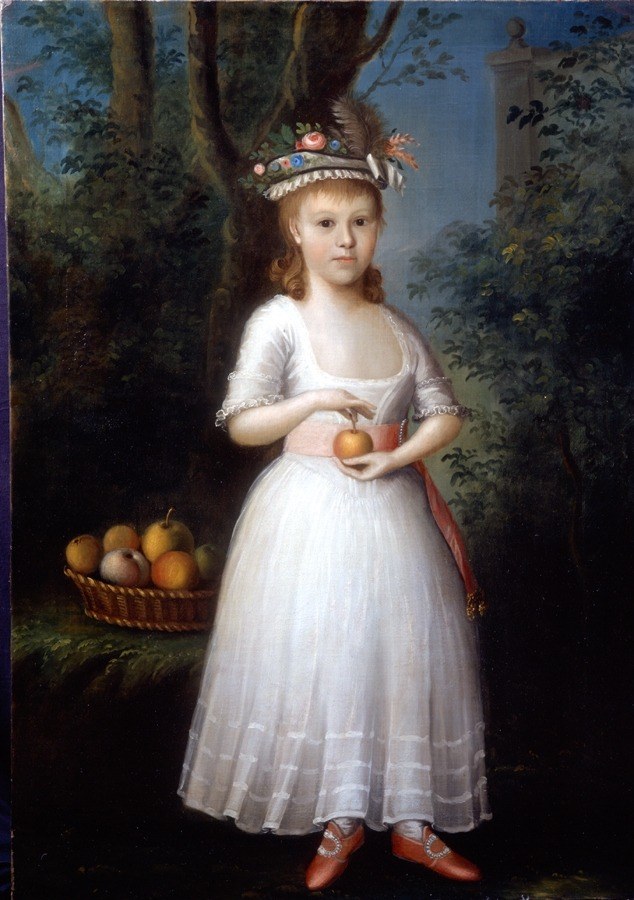
Portrait of a Young Girl holding an Apple. Image: Unidentified painter · Public domain · Wikimedia Commons, accessed 2026-08-04
Naïve Art (sometimes called Primitive Art, though that term is now largely avoided for its condescension) describes painting by self-taught artists working outside, or with little regard for, academic conventions of perspective, anatomy, and proportion. The result is not incompetence but a distinct visual logic: flattened space, bright and often unmixed color, obsessively detailed rendering of foliage, fabric, or crowds, and a directness of vision unfiltered by formal training. Where an academically trained painter learns to create convincing depth and correct proportion and then sometimes works to undo that training for expressive effect, naïve painters simply never acquired those conventions in the first place, producing images with a distinctive flatness and internal consistency of their own.
The style's most famous exponent, Henri Rousseau, worked as a Paris toll collector — earning him the nickname "Le Douanier," the customs officer — and painted entirely self-taught, producing lush, meticulously detailed jungle scenes populated by lions, tigers, and dreaming figures despite never leaving France. His combination of flattened perspective, jewel-like color, and calm, almost hallucinatory strangeness caught the attention of Paris's avant-garde, who championed and even collected his work, seeing in its unstudied directness something the academically trained could not easily fake. Rousseau's example encouraged critics and dealers to seek out and exhibit other self-taught painters, including Séraphine Louis, a French housekeeper who painted intensely detailed, visionary trees and flowers in her spare time, and the Georgian painter Niko Pirosmani, a self-taught sign-painter whose flat, iconic portraits and tavern scenes achieved a comparable directness.
Naïve Art did not rebel against an academic system so much as stand entirely outside it; its practitioners were rarely aware of, or interested in, the formal debates convulsing the Paris avant-garde. But that very outsider status is precisely what made the style valuable to insiders: at a moment when trained painters were consciously trying to unlearn academic convention in search of fresher, more direct vision, naïve painters offered an existing, unselfconscious model of exactly that directness. The movement matters because it complicated and expanded the definition of who counted as a serious artist, opening space for self-taught, working-class, and outsider practitioners within a modern art world otherwise dominated by academy-trained professionals.
What defines Naïve Art
Flattened, Non-Academic Perspective
Space is rendered without traditional linear perspective or foreshortening, often stacking or tilting planes so that background and foreground share similar visual weight and scale relationships feel intuitive rather than measured.
Bright, Often Unmixed Color
Colors tend toward saturated, clear hues applied with little blending or subtle gradation, giving compositions a vivid, direct, almost decorative clarity.
Obsessive, Meticulous Detail
Foliage, fabric patterns, crowds, and architectural ornament are frequently rendered leaf by leaf or figure by figure with painstaking, almost devotional patience, rather than summarized with looser painterly shorthand.
Disregard for Proportion and Anatomy
Figures, animals, and objects may be scaled according to their emotional or narrative importance rather than realistic size, producing a dreamlike or symbolic logic distinct from academic accuracy.
Dreamlike, Wonder-Filled Atmosphere
Despite technical simplicity, the combined effect is often strange, calm, and quietly hallucinatory — an atmosphere of wonder that later avant-garde artists prized precisely because it felt unstudied and impossible to fake.
Self-Taught, Outsider Origins
Naïve artists typically worked outside formal academies, often alongside other trades or occupations, painting evenings and weekends with no institutional training or exposure to contemporary art theory shaping their approach.
History
Naïve Art does not have a single founding moment so much as a gradual recognition by the trained art world of artists who had always existed outside it. Henri Rousseau, its central figure, began painting seriously in his forties while still employed at the Paris toll office, retiring in 1893 to paint full time, and first exhibited publicly at the Salon des Indépendants in 1886 — a venue without a jury that welcomed work the official Salon would have rejected. For years Rousseau's paintings were met largely with mockery from critics and the public, who found their flattened space and stiff figures simply amateurish.
That perception shifted around the turn of the century as younger avant-garde artists — increasingly skeptical of academic polish and drawn to what they saw as fresher, more direct forms of expression — began to take Rousseau seriously. Pablo Picasso reportedly staged a mock-serious banquet in Rousseau's honor in 1908, and Guillaume Apollinaire championed his work in print; both saw in Rousseau's untrained directness a quality worth learning from rather than correcting. Rousseau died in 1910 in poverty, only shortly before his reputation began its more serious ascent.
His example established a template that dealers, critics, and collectors then applied more broadly, seeking out other self-taught painters across Europe. Séraphine Louis, a housekeeper in Senlis, France, was discovered around 1912 by the German collector and critic Wilhelm Uhde, who had also written on Rousseau; he gave her her first major exhibitions in the late 1920s, after which the Depression ended his patronage and she was institutionalized in 1932, dying in an asylum in 1942. In Georgia, the self-taught sign- and portrait-painter Niko Pirosmani worked largely in obscurity, painting tavern signs and portraits for food and drink, and gained only limited recognition in his lifetime, with his reputation growing substantially after his death. The category broadened across the twentieth century to include outsider and folk painters worldwide, and remains an active, if loosely defined, way of categorizing self-taught artists today.
Key works
| Work | Artist | Year | Why it matters |
|---|---|---|---|
| The Sleeping Gypsy | Henri Rousseau | 1897 | A calm, dreamlike desert scene of a sleeping figure watched by a lion, among the most reproduced images associated with Naïve Art. |
| The Dream | Henri Rousseau | 1910 | Rousseau's final major painting, combining a nude reclining on a divan with an invented jungle, exhibited shortly before his death. |
| Actress Margarita | Niko Pirosmani | 1909 | A flat, iconic portrait by the self-taught Georgian sign-painter, among his most celebrated works. |
How to make art in this style
Painting in a Naïve style rewards patience and directness over technical polish.
Perspective and space: Skip formal linear perspective. Let background elements sit at a similar scale and visual weight to the foreground rather than receding convincingly — stacking planes or tilting a ground plane upward toward the viewer is characteristic of the style.
Palette: Use bright, clear, largely unmixed colors straight from the tube or palette, applied in flat areas rather than subtly blended gradations. Favor high-key greens, warm yellows, and saturated reds and blues.
Detail and pattern: Render texture-heavy elements — leaves, grass, fabric, crowds — with patient, almost obsessive individual detail rather than summarizing them with a few loose strokes. Painting each leaf or each figure in a crowd separately, however time-consuming, is central to the naïve look.
Proportion: Size figures and objects according to their importance in the scene rather than strict realism — a beloved subject can be rendered larger than accurate perspective would allow, without this reading as a mistake.
Subjects: Personal, everyday, or imagined subjects work well — a garden, a family gathering, an invented exotic landscape, animals, or a remembered place. Painting from imagination or memory rather than careful observation supports the style's dreamlike quality.
Mindset: The most important ingredient is sincerity rather than technique — approach the subject with direct, unguarded attention rather than trying to simulate "bad" technique ironically, since the style's charm depends on genuine, unselfconscious vision.
Legacy
Naïve Art's influence runs less through direct stylistic imitation than through the precedent it set: that untrained, unstudied vision could hold real artistic value, and that an artist's authority need not depend on academic credentials. Henri Rousseau's example directly shaped how the Paris avant-garde thought about "primitive" and folk sources more broadly, feeding into other artists' engagement — however complicated and appropriative by today's standards — with non-Western and outsider visual traditions during the birth of Cubism and Fauvism. Rousseau's flattened, densely patterned jungle scenes also became a recognizable visual template still echoed in illustration, animation, and design whenever a lush, dreamlike "invented jungle" mood is wanted.
More broadly, the category helped establish "outsider art" and "folk art" as legitimate, actively collected fields, with institutions and specialized dealers now dedicated to self-taught practitioners worldwide. The naïve painter's combination of technical simplicity and emotional or visionary intensity continues to appeal precisely because it resists the polish of formal training, offering a recurring reminder — invoked by generations of trained artists trying to recover a fresher way of seeing — that skill and vision are not the same thing.
Frequently asked questions
What is Naïve Art?
Naïve Art describes painting by self-taught artists who work outside academic conventions of perspective and proportion, producing flattened, brightly colored, meticulously detailed images. Henri Rousseau is its best-known example.
What is the difference between Naïve Art and folk art?
The terms overlap considerably. "Folk art" more often describes work rooted in a specific regional or cultural craft tradition passed down informally, while "Naïve Art" emphasizes an individual self-taught painter working without academic training, though many artists and works are described by both terms.
Why did the avant-garde admire Henri Rousseau's work?
Trained artists who were themselves trying to move away from academic polish saw in Rousseau's untrained directness, flattened space, and unselfconscious vision a freshness and authenticity that was difficult to consciously replicate.
Is "Naïve Art" the same as "outsider art"?
They're related but not identical. Outsider art is a broader twentieth-century category that includes self-taught artists working entirely outside the art world, sometimes with no awareness of it at all, while Naïve Art specifically describes untrained painters whose work nonetheless engaged with, or was embraced by, the mainstream art world.
Who are the best-known Naïve artists?
Henri Rousseau is the movement's central figure; Séraphine Louis and Niko Pirosmani are among the other widely recognized self-taught painters associated with the style.