 Art
Art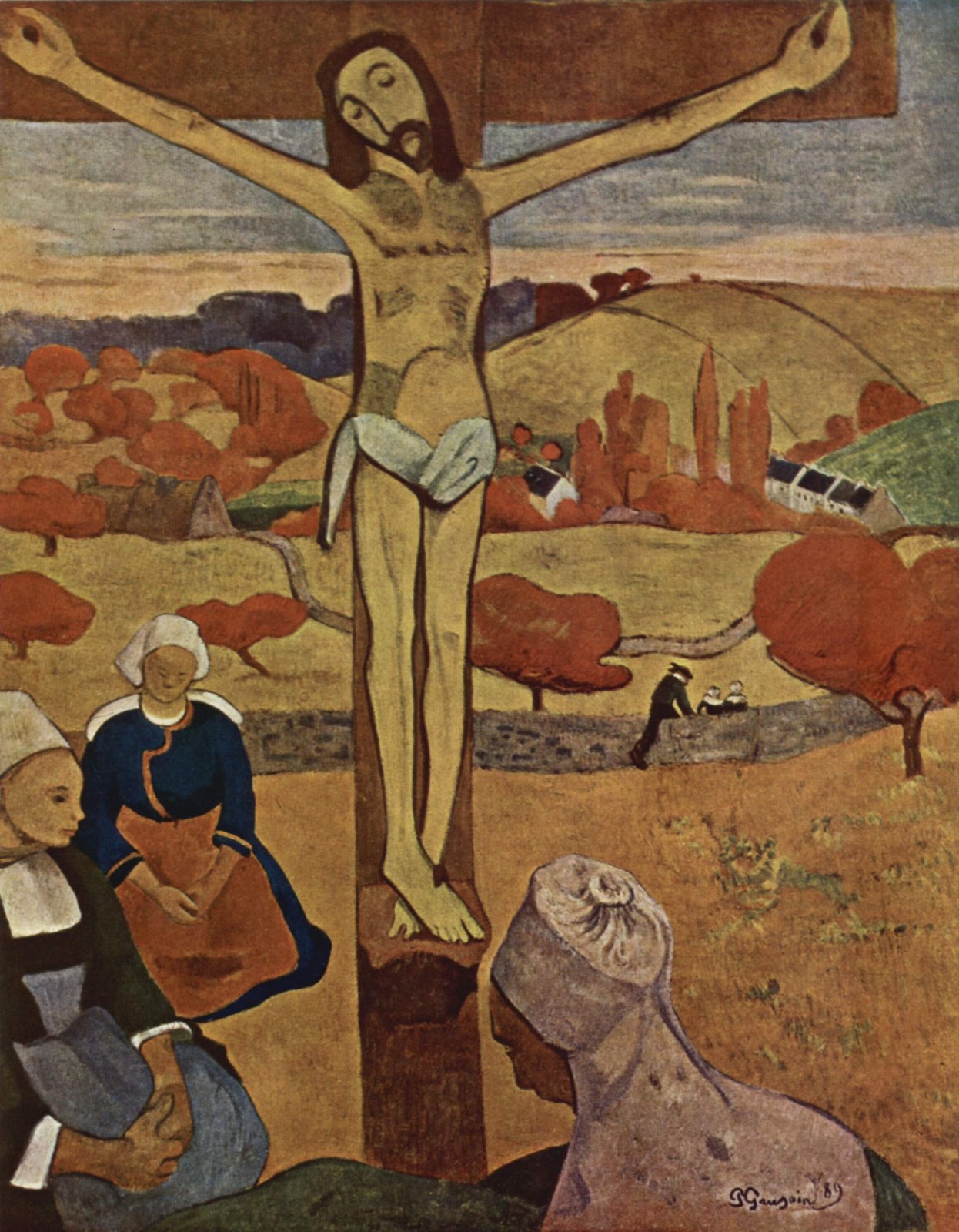
The Yellow Christ. Image: Paul Gauguin · Public domain · Wikimedia Commons, accessed 2026-08-04
Cloisonnism takes its name from cloisonné, the ancient enamelwork technique in which thin metal strips (cloisons, French for "partitions") separate pools of colored enamel on a metal base. Applied to painting, the term describes a style in which broad, flat areas of pure, often non-naturalistic color are bounded by heavy, dark contour lines — much like the leading in a stained-glass window. Depth, modeling, and cast shadow are largely abandoned in favor of pattern, silhouette, and decorative clarity.
The style emerged in France around 1887–1888, primarily through the young painters Émile Bernard and Louis Anquetin, who were looking for an alternative to both Impressionism's dissolving light and the fussy detail of academic painting. Anquetin's street scene of a Paris avenue at dusk, with its flattened figures rimmed in dark outline under gaslight, is often cited as an early landmark. Bernard, then twenty, developed the approach further at Pont-Aven in Brittany, where his pivotal collaboration with Paul Gauguin took shape in the summer of 1888. The two exchanged ideas intensely — a collaboration whose exact division of credit both artists disputed for the rest of their lives — and Gauguin's Vision After the Sermon, painted that same summer, became the style's most famous single work: a flat vermilion field, Breton women in white coifs, and a wrestling match rendered with almost no illusionistic space.
Cloisonnism rebelled against two things at once: the Impressionists' insistence on transient optical sensation, and academic painting's polished realism. In their place it offered a frankly artificial, flattened surface that owed as much to popular and applied art — stained glass, folk woodcuts, cloisonné enamels, and Japanese prints — as to the fine-art tradition. Color was freed to be symbolic or emotional rather than descriptive; a field could be red simply because red suited the mood, not because that was its observed hue.
Though short-lived as a distinct label — it was quickly absorbed into the broader, more conceptually ambitious Synthetism also developing at Pont-Aven — Cloisonnism's visual vocabulary of flat color bounded by dark outline became one of the most widely borrowed devices in modern art, from Art Nouveau graphics to Fauvism and beyond.
What defines Cloisonnism
Heavy Dark Outlines
Forms are enclosed by thick, continuous contour lines, usually black or dark blue, that function like the metal cloisons in enamelwork, separating one color field from the next and flattening the picture into distinct compartments.
Flat, Unmodulated Color
Colors are applied as broad, even fields with little or no internal shading or gradation, so a face, a tree, or a robe reads as a single flat plane of hue rather than a modeled, three-dimensional form.
Suppressed Perspective and Depth
Traditional illusionistic space gives way to a shallow, almost decorative picture plane. Foreground and background can occupy similar visual weight, closer to a tapestry or stained-glass panel than a window onto a scene.
Non-Naturalistic, Symbolic Color
Hues are chosen for emotional or decorative impact rather than observed accuracy — a field of grass might be rendered vermilion, a sky yellow, freeing color from its descriptive duty.
Sources in Applied and Popular Art
The style deliberately drew on stained glass, cloisonné enamel, Japanese woodblock prints, and folk imagery, elevating decorative traditions to the status of fine-art technique.
Simplified, Bold Compositions
Figures and objects are reduced to clear, simplified silhouettes, often arranged in flattened, frieze-like groupings, prioritizing graphic clarity and rhythm over anatomical or spatial nuance.
History
Cloisonnism crystallized in Paris in 1887, when the painters Émile Bernard, then still a teenager, and Louis Anquetin, in his mid-twenties, both formed by Fernand Cormon's atelier, began experimenting with flat color fields bounded by dark outlines — a response, in part, to Georges Seurat's rigorous pointillism, which the two younger painters found overly scientific and cold. Anquetin's Avenue de Clichy: Five O'Clock in the Evening, shown in 1888, demonstrated the technique on a Parisian street scene lit by gaslight. The critic Édouard Dujardin gave the style its name in an 1888 review, borrowing the term from cloisonné enamelwork to describe the effect of color "compartments" divided by outline.
The decisive development came that same summer, when Bernard traveled to Pont-Aven in Brittany and met Paul Gauguin, who was already an established, if still struggling, painter twenty years his senior. Working alongside each other and in close, sometimes tense dialogue — Bernard later insisted he had originated the ideas Gauguin made famous — the two produced some of the style's defining works, including Bernard's Breton Women in a Meadow and Gauguin's Vision After the Sermon. Gauguin's charisma and connections meant his versions of the style reached a wider audience and absorbed most of the credit, a source of lasting bitterness for Bernard.
Cloisonnism was never a large or long-lived movement in its own right; within a year or two its core ideas were folded into the broader, more theoretically developed Synthetism associated with the Pont-Aven school, and by the mid-1890s the specific term had largely fallen out of use even as its visual logic persisted. Its outline-and-flat-color approach nonetheless left a durable mark, feeding directly into Les Nabis, Art Nouveau's graphic design, and the broader early-modernist turn away from illusionistic depth.
Key works
| Work | Artist | Year | Why it matters |
|---|---|---|---|
| Vision After the Sermon (Jacob Wrestling with the Angel) | Paul Gauguin | 1888 | The style's signature image: a flat vermilion field and heavy black outlines around Breton women witnessing a Biblical vision. |
| Avenue de Clichy: Five O'Clock in the Evening | Louis Anquetin | 1887 | An early, often-cited landmark applying dark-outlined flat color to a modern Parisian street scene under gaslight. |
| The Yellow Christ | Paul Gauguin | 1889 | Extends the cloisonnist technique to a devotional subject, with a flattened crucifixion rendered in bold yellow fields against the Breton landscape. |
How to make art in this style
Cloisonnism is one of the more approachable historical styles to practice because its rules are graphic rather than painterly.
Palette: Choose a small number of saturated, high-contrast colors — vermilion, chrome yellow, deep blue, emerald green — and commit to using each as a single flat value rather than a blended range. Non-naturalistic choices are encouraged: paint a field red or a sky yellow if it serves the composition's mood.
Composition: Start by simplifying your subject into large, clear shapes — think of translating a scene into a coloring-book page before adding color. Flatten depth deliberately: avoid strong cast shadows, atmospheric perspective, or graduated modeling that would suggest three-dimensional space.
Technique: Draw or paint a confident, continuous dark outline (black, deep blue, or brown) around every shape first, as if leading a stained-glass window. Then fill each enclosed area with one flat, even color, keeping brushwork invisible within each field — the outline, not the brushstroke, should carry the visual energy. Resist any urge to blend or shade inside a compartment.
Subjects: The style suits scenes with clear, separable shapes — figures in traditional dress, landscapes with distinct fields and tree lines, religious or symbolic tableaux, still lifes with simple objects. Avoid subjects that depend on subtle tonal transitions, like smoke, water reflections, or soft portrait modeling, since these resist the flat-compartment approach.
Finishing touch: Keep the overall palette limited and harmonious across the whole composition — Cloisonnism reads as unified and decorative, not as a patchwork of unrelated colors.
Legacy
Cloisonnism's life as a named style was brief, but its central device — flat color compartmentalized by strong outline — proved extraordinarily portable. It fed almost immediately into Synthetism and Les Nabis, where painters continued to flatten and simplify pictorial space. The same outline-and-fill logic reappears in Art Nouveau graphic design and poster art of the 1890s, where clean contour and flat color were ideally suited to printing and mass reproduction, and it echoes again in the bold black outlines and flat planes of twentieth-century comic art, stained glass revival, and graphic illustration.
Because Cloisonnism treated color as symbolic and decorative rather than descriptive, it also helped license the even bolder, more arbitrary color choices of the Fauves and German Expressionists a generation later. Today, the style's visual signature — confident dark contours enclosing flat, saturated color — remains instantly recognizable in stained glass, batik and textile design, and any illustration style that favors graphic clarity over naturalistic shading, a testament to how thoroughly a short-lived 1880s experiment reshaped the vocabulary of flat design.
Frequently asked questions
What is Cloisonnism?
Cloisonnism is a late-1880s painting style in which broad, flat areas of pure color are separated by heavy, dark outlines, resembling the metal partitions (cloisons) of cloisonné enamelwork or the leading in stained glass.
Who invented Cloisonnism?
Émile Bernard and Louis Anquetin developed the style's core ideas in Paris around 1887, and Paul Gauguin adopted and popularized it after their pivotal 1888 collaboration at Pont-Aven; the two disputed credit for decades.
What's the difference between Cloisonnism and Synthetism?
Cloisonnism refers specifically to the technique of flat color bounded by dark outline, while Synthetism is the broader theory — also developed at Pont-Aven — that painting should synthesize memory, emotion, and observed form rather than copy nature directly. Cloisonnism is often described as Synthetism's visual technique.
Where did the name Cloisonnism come from?
The critic Édouard Dujardin coined it in an 1888 review, borrowing the term cloisonné from the enamelwork technique in which thin metal strips divide pools of colored enamel.
What is the most famous Cloisonnist painting?
Paul Gauguin's Vision After the Sermon, 1888, with its flat vermilion ground and heavily outlined figures, is generally considered the style's defining work.