 Art
Art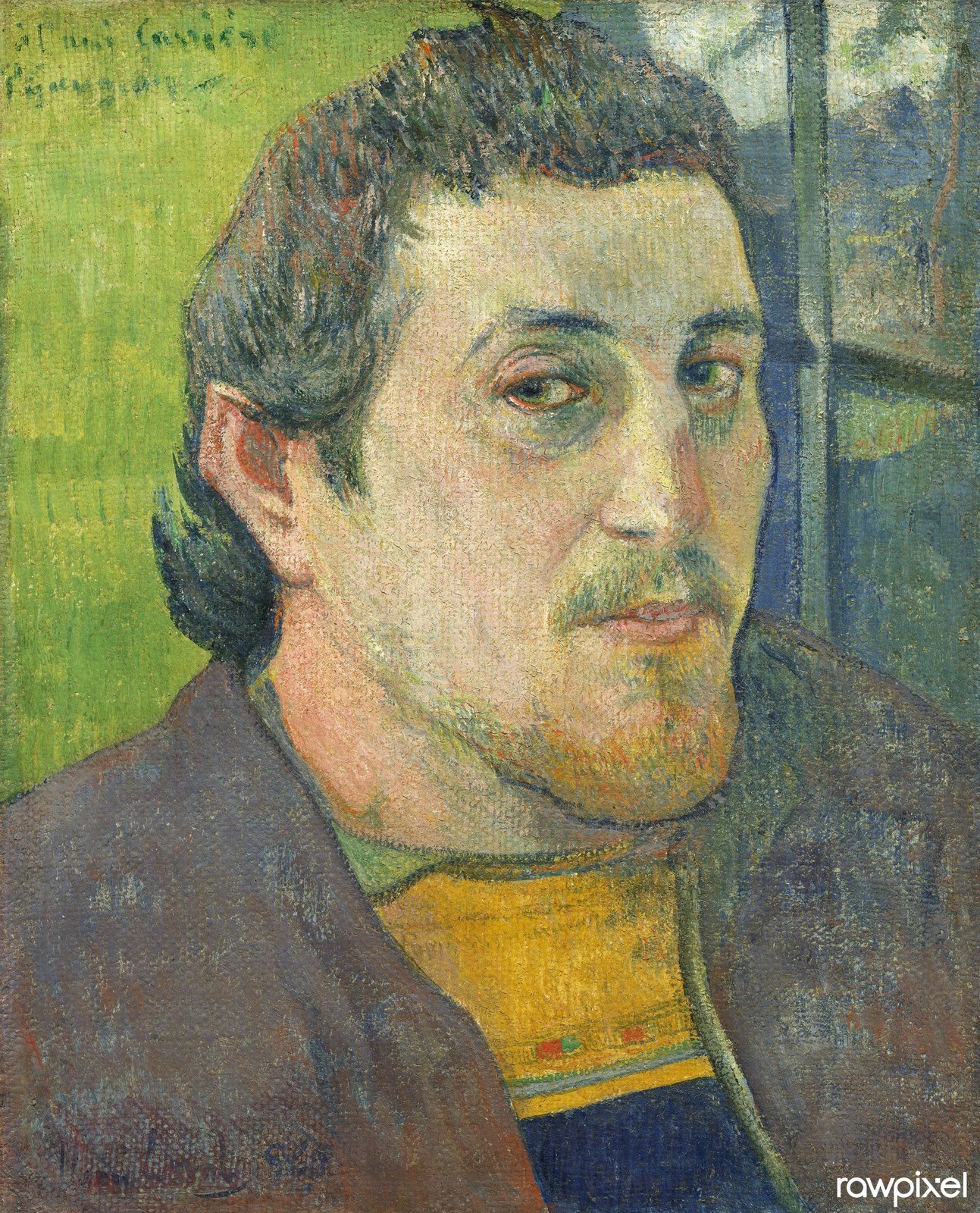
Self-Portrait Dedicated to Carrière (1888) by Paul Gauguin. Original from The National Gallery of Art. Digitally enhanced by rawpixel. (50623825532). Image: Rawpixel Ltd · CC BY 2.0 · Wikimedia Commons, accessed 2026-08-04
Synthetism is the theoretical framework behind the flattened, outlined paintings produced at Pont-Aven in Brittany from 1888 onward — the intellectual scaffolding for what Cloisonnism supplied technically. Where Cloisonnism describes a look (flat color, dark contour), Synthetism describes a method: painting should "synthesize" three things — the artist's observation of nature, the artist's feeling about the subject, and considerations of pure aesthetic form (line, color, composition) — rather than simply transcribe visual appearance.
The term and its clearest early demonstration come from an afternoon in 1888 when Paul Gauguin, painting alongside the younger Paul Sérusier in the Bois d'Amour near Pont-Aven, instructed him to paint what he felt rather than what convention dictated, using bold, unmixed color for shadow, foliage, and light alike. The small landscape Sérusier produced under this guidance, later nicknamed The Talisman, became a founding icon — proof that color need not describe what the eye sees but could instead express what the mind and heart supply.
Synthetist painters accordingly worked as much from memory and imagination as from direct observation, often composing in the studio rather than en plein air. Gauguin's Vision After the Sermon shows Breton women experiencing a religious vision inside their own minds, rendered with the same pictorial weight as the physical scene around them — memory, belief, and observed fact synthesized into one flat, unified image. Émile Bernard pursued similar aims, simplifying Breton peasant life into bold, legible shapes drained of incidental detail.
Synthetism rebelled against both Impressionism's dependence on the optical moment and academic painting's insistence on faithful transcription. It argued that a painting was not a window but a constructed, deliberately artificial object — closer to a decorative or symbolic sign than a photograph. This idea, more than any specific technique, proved to be the movement's lasting contribution: it gave later painters philosophical permission to distort, simplify, and invent, rather than merely record. Synthetism's Pont-Aven circle dispersed by the mid-1890s, but its central premise — that painting should synthesize inner and outer reality — fed directly into Les Nabis and, more broadly, into the Symbolist ambitions shared across fin-de-siècle European art.
What defines Synthetism
Painting from Memory and Imagination
Synthetist painters often worked away from the motif, in the studio, relying on memory, feeling, and invention rather than direct observation, treating recollection as a legitimate — even preferable — source for a picture.
Synthesis of Observation, Feeling, and Form
The core theory held that a painting should fuse three elements: what is seen in nature, what the artist feels about it, and the abstract demands of line, color, and composition, rather than privileging any one alone.
Arbitrary, Symbolic Color
Color was assigned by feeling rather than fact — a shadow could be pure ultramarine, foliage could be vermilion — following the principle of painting a subject as it is felt rather than strictly observed.
Simplified, Flattened Forms
Figures and landscape elements were reduced to their essential outlines and masses, discarding incidental detail in favor of clear, legible, almost sign-like shapes.
Symbolic and Spiritual Subject Matter
Religious visions, Breton folk custom, and inner psychological states appear alongside — and with equal pictorial weight to — everyday observed scenes, blurring the line between the real and the imagined.
Decorative Unity
Compositions were conceived as unified decorative wholes, with color and shape balanced across the whole canvas rather than built up from independently observed details.
History
Synthetism took shape at Pont-Aven, a Breton village that had attracted an art colony since the 1860s for its affordable living and unspoiled rural character. Paul Gauguin first visited in 1886, drawn by the low cost of living as much as the scenery, and returned in the summers of 1888 and 1889 as his ideas matured. The pivotal moment came in 1888, when the twenty-year-old Émile Bernard arrived at Pont-Aven already experimenting with flat color and outline (soon labeled Cloisonnism) and began an intense exchange of ideas with Gauguin. That same summer, Gauguin gave Paul Sérusier the informal lesson in the Bois d'Amour that produced The Talisman, and painted his own breakthrough work, Vision After the Sermon.
The word "Synthetism" itself was promoted mainly by Bernard and the critic Albert Aurier, who in a widely read 1891 essay in the Mercure de France championed Gauguin as the leader of a Symbolist painting movement grounded in synthesis — a piece of critical framing that cemented Gauguin's reputation as the group's central figure, to Bernard's lasting frustration, since Bernard felt his own contributions had been overshadowed.
Sérusier carried the Pont-Aven lessons back to Paris, showing The Talisman to fellow students at the Académie Julian, which directly catalyzed the formation of Les Nabis later in 1888. Synthetism therefore functioned less as a movement with its own long institutional life and more as a hinge: it absorbed and extended Cloisonnism's technique, and it fed almost immediately into the Nabis' broader decorative and Symbolist program. Gauguin's own departure for Tahiti in 1891 effectively ended the Pont-Aven colony's most productive period, and by the mid-1890s the specific Pont-Aven Synthetist circle had dispersed, its ideas already absorbed into the wider Symbolist and Nabi currents of the 1890s Paris art world.
Key works
| Work | Artist | Year | Why it matters |
|---|---|---|---|
| The Talisman | Paul Sérusier | 1888 | A small landscape painted under Gauguin's direct guidance that became the founding icon of both Synthetism and, soon after, Les Nabis. |
| Vision After the Sermon (Jacob Wrestling with the Angel) | Paul Gauguin | 1888 | Fuses an observed Breton scene with an imagined religious vision in one flat plane, demonstrating Synthetist theory in practice. |
| The Yellow Christ | Paul Gauguin | 1889 | Merges a roadside Breton crucifix with the surrounding landscape and worshippers, treating devotional memory and physical place as equally real. |
| Self-Portrait with Halo | Paul Gauguin | 1889 | A knowingly symbolic self-image, with apple and serpent, that shows Synthetism's willingness to blend observed likeness with invented, allegorical content. |
How to make art in this style
Practicing Synthetism today means prioritizing memory and feeling over direct copying.
Method: Try working partly or wholly from memory rather than a live model or photograph. Observe a scene, then step away and paint it from recollection, letting details you've forgotten fall away naturally — what remains is often the essential, synthesized image the theory prizes.
Palette: Assign color by feeling rather than fact. Before painting a shadow, foliage, or sky, ask what color expresses the mood you want rather than what a camera would record; commit to that choice as a flat, confident area of pure pigment.
Composition: Simplify aggressively. Reduce a scene to its essential shapes and eliminate incidental detail — a Synthetist composition should read clearly at a glance, more like a decorative panel or emblem than a documentary record. Balance shapes and colors across the whole canvas as a unified design rather than building the image detail by detail.
Combining registers: Consider layering an observed scene with a remembered, imagined, or symbolic element within the same flat pictorial space, treating both as equally "real" — a technique central to Synthetist works that blend physical setting with vision or memory.
Subjects: Rural or folk life, religious or symbolic scenes, and landscapes with strong, simplified masses all suit the approach well. Avoid subjects that depend on fine tonal or atmospheric nuance, since Synthetism favors bold, legible synthesis over detailed transcription.
Legacy
Synthetism's lasting contribution was less a specific look than a permission: the idea that a painting could legitimately synthesize memory, emotion, and formal invention rather than simply transcribe the visible world. That premise fed directly into Les Nabis, whose members — several of them former Académie Julian students who saw Sérusier's Talisman firsthand — built an entire decorative, Symbolist program on it through the 1890s. It also underwrote the wider Symbolist movement's insistence that art should express ideas and inner states rather than describe appearances.
Further afield, Synthetism's theoretical stance — that observation, feeling, and formal design should be fused rather than ranked — anticipated central tenets of twentieth-century modernism, from Expressionism's emotional distortion of form to early abstraction's departure from representation altogether. Gauguin's subsequent Tahitian work, itself an extension of Synthetist thinking, became one of the most influential — and, in retrospect, most contested — bodies of work in modern art, prized for its color and simplification while increasingly scrutinized for its colonial gaze. Synthetism's core lesson — that a painting is a constructed synthesis, not a transcription — remains foundational to how art students are still taught to think about composition today.
Frequently asked questions
What is Synthetism?
Synthetism is a late-1880s art theory, developed at Pont-Aven, holding that a painting should synthesize observed nature, the artist's feeling, and formal design rather than simply record visual appearance.
What's the difference between Synthetism and Cloisonnism?
Cloisonnism describes the visual technique — flat color bounded by dark outline — while Synthetism describes the underlying theory that painting should fuse memory, emotion, and observation; the two developed together at Pont-Aven and are often treated as technique and theory of the same movement.
What is The Talisman and why does it matter?
The Talisman is a small 1888 landscape Paul Sérusier painted at Pont-Aven under Paul Gauguin's direct verbal instruction to use pure, non-naturalistic color. It became the founding icon of Synthetism and directly inspired the formation of Les Nabis.
Is Synthetism the same as the Pont-Aven School?
They largely overlap — "Pont-Aven School" refers to the community of painters, led by Gauguin, who worked in that Breton village, while "Synthetism" names the artistic theory that community developed and practiced.
Who were the leading Synthetist painters?
Paul Gauguin, Émile Bernard, and Paul Sérusier are the central figures, with Gauguin generally credited as the group's most influential and famous member.