 Art
Art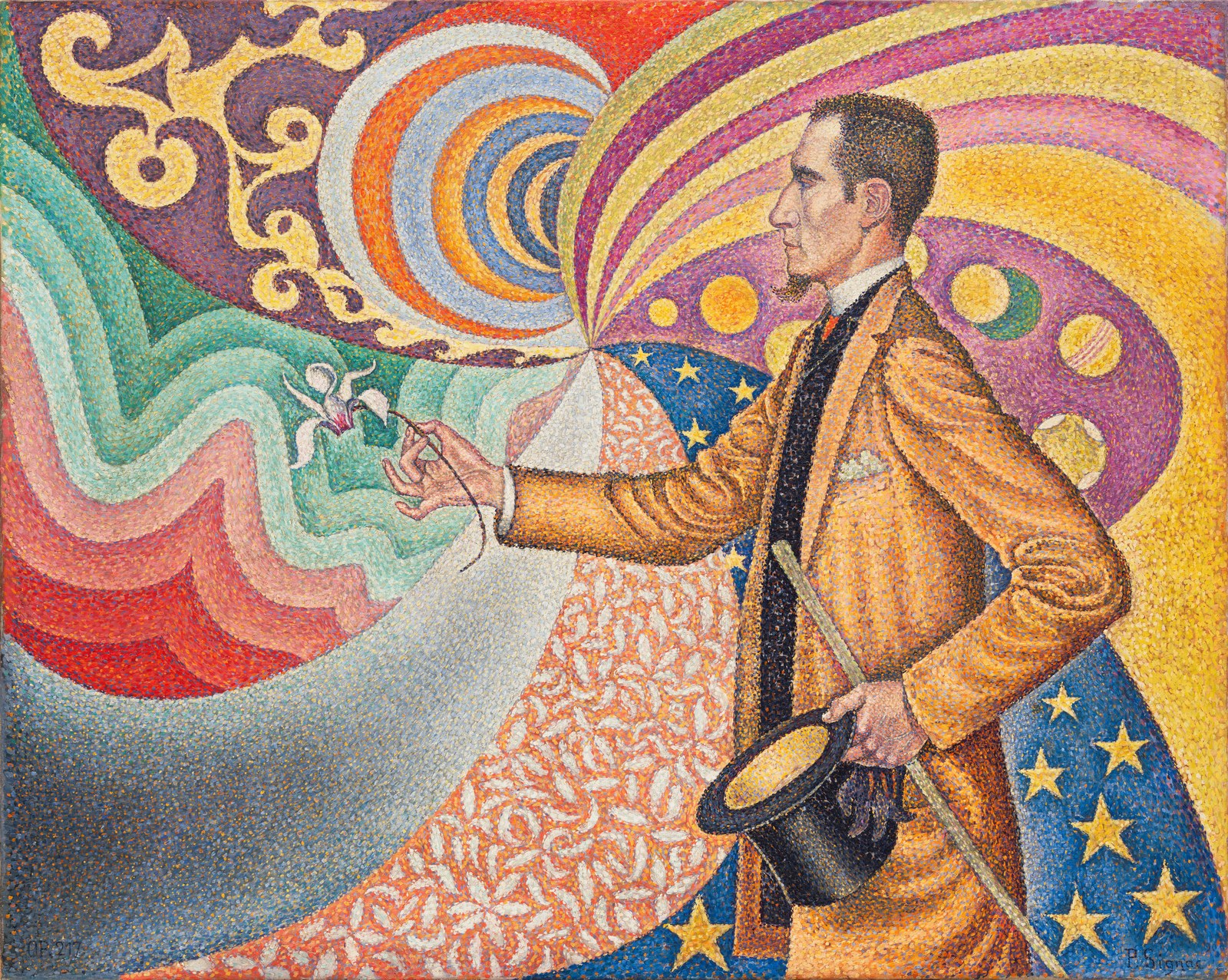
French: Opus 217. Sur l'émail d'un fond rythmique de mesures et d'angles, de tons et de teintes, Portrait de M. Félix Fénéon en 1890Opus 217. Against the Enamel of a Background Rhythmic with Beats and Angles, Tones, and Tints, Portrait of M. Félix Fénéon in 1890. Image: Paul Signac · Public domain · Wikimedia Commons, accessed 2026-08-04
Neo-Impressionism, also known as Pointillism or Divisionism, emerged in France in the mid-1880s when Georges Seurat, joined soon after by Paul Signac and Henri-Edmond Cross, sought to put Impressionism's intuitive handling of color on a rigorous, near-scientific footing. Rather than applying paint in loose, expressive dabs, Neo-Impressionists built their canvases from small, discrete dots or strokes of pure, unmixed color, placed according to color theory so that the viewer's eye would blend them optically at a distance, producing colors more luminous and vibrant than any physical mixture on a palette could achieve.
Visually, a Neo-Impressionist canvas is instantly recognizable up close: countless tiny, evenly sized dots of contrasting color covering the entire surface, including figures, sky, and even the painted border some artists added around the canvas edge. From a normal viewing distance, these dots resolve into shimmering, cohesive form and atmosphere, an effect the artists based on contemporary color science, particularly the writings of chemist Michel-Eugène Chevreul on simultaneous contrast and Ogden Rood on optical color mixing.
The movement rebelled against what Seurat saw as Impressionism's overly casual, intuitive approach to color and composition. Where Monet or Renoir worked rapidly and spontaneously outdoors, Seurat composed his major paintings slowly and deliberately in the studio, over months, using numerous preparatory drawings and oil sketches, applying color according to calculated theory rather than impulse. The result retained Impressionism's bright palette and modern subject matter, café-concerts, riverside leisure, the circus, while imposing a much more rigid, almost architectural sense of order and permanence.
Neo-Impressionism matters as both the logical extension and the critique of Impressionism, proving that its color discoveries could be systematized into a repeatable method, and as a crucial bridge toward twentieth-century abstraction, since its dot-by-dot construction of the picture surface drew attention to painting's underlying structure in a way later Fauvist and Cubist artists, several of whom passed through a Neo-Impressionist phase, would build on directly.
What defines Neo-Impressionism
Small, distinct dots of pure color
Paint was applied as tiny, evenly sized points or short strokes of unmixed color rather than blended on the palette, relying on the viewer's eye to fuse them at a normal viewing distance.
Scientific color theory
Color choices followed contemporary optical theory, particularly simultaneous contrast and the systematic pairing of complementary colors, rather than the more intuitive color decisions typical of Impressionist painting.
Slow, deliberate studio construction
Unlike the rapid, direct outdoor execution of Impressionism, major Neo-Impressionist paintings were built up methodically over months in the studio from numerous preparatory studies.
Monumental stillness and order
Figures and compositions often feel frozen, geometrically simplified, and formally arranged, closer to the calm structure of a frieze than to Impressionism's sense of a fleeting, spontaneous moment.
Even, all-over surface treatment
The same small-dot technique was applied uniformly across the entire canvas, sky, water, figures, and sometimes even the painted frame, unifying the whole surface as a single optical field.
Bright, high-key luminosity
Because complementary colors placed side by side intensify each other optically, finished paintings often appear more vibrant and glowing than works using conventional pigment mixing.
History
Neo-Impressionism began with Georges Seurat, who trained academically before turning to a rigorous study of contemporary color science, including the writings of Michel-Eugène Chevreul on simultaneous contrast and later Charles Henry and Ogden Rood on optical color mixing and the emotional effects of line and color. Seurat spent roughly two years developing his technique and preparatory studies for his first major dot-based painting, A Sunday Afternoon on the Island of La Grande Jatte, exhibited in 1886.
That painting debuted at the final Impressionist group exhibition in 1886, where it caused an immediate sensation and effectively split the Impressionist circle. Camille Pissarro, one of the movement's founding members, was sufficiently impressed to adopt the pointillist technique himself for several years, lending it credibility, though he eventually returned to a looser Impressionist style. Critic Félix Fénéon championed the new approach and coined the term "Neo-Impressionism" to describe it that same year.
Paul Signac became Seurat's closest collaborator and, after Seurat's early death in 1891 at only thirty-one, the movement's leading theorist and practitioner, publishing a book in 1899 that codified Neo-Impressionist color theory for a wider audience. Henri-Edmond Cross joined the circle in the late 1880s, eventually settling in the south of France and developing a looser, more mosaic-like variant of the technique in brighter Mediterranean color.
Seurat's death removed the movement's central figure just five years after its breakthrough, and without him Neo-Impressionism gradually loosened into looser divisionist handling through the 1890s. Its strict application faded by around 1900, but its influence proved disproportionate to its short lifespan: Henri Matisse worked briefly in a Neo-Impressionist manner around 1904 to 1905 before launching Fauvism, and the movement's systematic, structural approach to color and surface fed directly into early twentieth-century modernism.
Key works
| Work | Artist | Year | Why it matters |
|---|---|---|---|
| A Sunday Afternoon on the Island of La Grande Jatte | Georges Seurat | 1886 | The movement's founding masterpiece, a large, meticulously composed park scene built entirely from tiny dots of pure color. |
| Bathers at Asnières | Georges Seurat | 1884 | Seurat's earlier large-scale riverside scene, painted just before he fully adopted the pointillist dot technique, showing the transition toward it. |
| Le Chahut | Georges Seurat | 1890 | A cabaret dance scene using rhythmic line and color theory to convey the energy and gaiety of the performance. |
| Portrait of Félix Fénéon | Paul Signac | 1890 | A striking portrait of the critic who coined the term Neo-Impressionism, set against a swirling, decoratively patterned background. |
| The Circus | Georges Seurat | 1891 | Seurat's unfinished final major painting, depicting a circus performance with even greater rhythmic stylization than his earlier work. |
How to make art in this style
Palette. Work from a limited set of pure, high-intensity pigments, avoiding pre-mixed colors on the palette. Choose complementary pairs, red and green, blue and orange, yellow and violet, and place them near each other in small marks so they intensify one another optically rather than muddying together.
Composition. Plan the composition carefully and slowly before applying paint, favoring calm, geometrically balanced arrangements over spontaneous or asymmetrical framing. Simplify figures into clear, somewhat stylized silhouettes, echoing the flattened, frieze-like stillness typical of the style rather than capturing fleeting motion.
Technique. Apply paint as small, evenly sized dots or short strokes across the entire canvas, working methodically and covering the full surface, sky, ground, figures alike, with the same consistent mark. Keep dot size and spacing fairly regular; the optical blending effect depends on marks small enough, relative to viewing distance, to fuse into continuous color and form rather than reading as separate specks.
Value and contrast. Use adjacent dots of different but related hues to build both color intensity and the sense of light and shadow, rather than relying on black or grey for shading. Test the painting from a normal viewing distance periodically; the dots should resolve into smooth gradations and luminous color rather than remaining a visibly separate pattern.
Subjects. Everyday leisure scenes, parks, riverbanks, beaches, cafés, suit the style well, as does any subject that benefits from a sense of calm, monumental stillness rather than captured motion. Because the technique is slow and deliberate, working from careful preparatory studies rather than direct rapid observation fits the method better than plein air spontaneity.
Legacy
Neo-Impressionism's most direct legacy runs through Henri Matisse, who worked briefly in the pointillist technique around 1904 before loosening its small, controlled dots into the broader, wilder patches of pure color that launched Fauvism, carrying the movement's core insight, that color intensity could be built through juxtaposition rather than blending, into a freer, more expressive register. The movement's systematic attention to the picture's surface as a constructed field of discrete marks also anticipated aspects of Cubism and later abstraction, which likewise treated the canvas as a built structure rather than a transparent window.
Beyond painting, Neo-Impressionism's underlying principle, that separate points of color can fuse into a coherent image through optical mixing at the viewer's eye, closely parallels the technical basis of modern color printing and display technology, where tiny dots or pixels of a few primary colors combine to form full-color images, a connection frequently drawn by design and media historians even though the artists themselves worked a half-century before such technologies existed.
Paul Signac's decades of continued practice and theoretical writing kept the movement's ideas circulating well into the twentieth century, influencing later color-focused abstraction. Today, Seurat's La Grande Jatte remains one of the most recognized and widely reproduced paintings in Western art, its dot-built stillness instantly identifiable even to viewers unfamiliar with the movement's name or scientific underpinnings.
Frequently asked questions
What is Neo-Impressionism?
Neo-Impressionism is a painting movement that began in France around 1884, in which artists applied small, distinct dots or strokes of pure color, based on scientific color theory, so the viewer's eye would blend them optically into brighter, more luminous form than conventional pigment mixing could achieve.
What is the difference between Pointillism and Neo-Impressionism?
The terms are closely related and often used interchangeably. Neo-Impressionism is the broader movement name, while Pointillism specifically describes the small-dot painting technique most associated with it.
Who started Neo-Impressionism?
Georges Seurat developed the technique, debuting it with his 1886 painting A Sunday Afternoon on the Island of La Grande Jatte. Paul Signac became his closest collaborator and, after Seurat's death in 1891, the movement's leading theorist.
How is Neo-Impressionism different from Impressionism?
Impressionism relied on rapid, intuitive brushwork applied directly outdoors to capture a fleeting moment of light. Neo-Impressionism applied color according to systematic scientific theory, using small, uniform dots built up slowly and deliberately in the studio, producing calmer, more structured compositions.
Why did Georges Seurat use dots in his paintings?
Seurat believed that placing small dots of pure, unmixed color side by side, rather than blending them on the palette, would let the viewer's eye combine them optically, producing more vibrant and luminous color based on contemporary scientific theories of color perception.