 Art
Art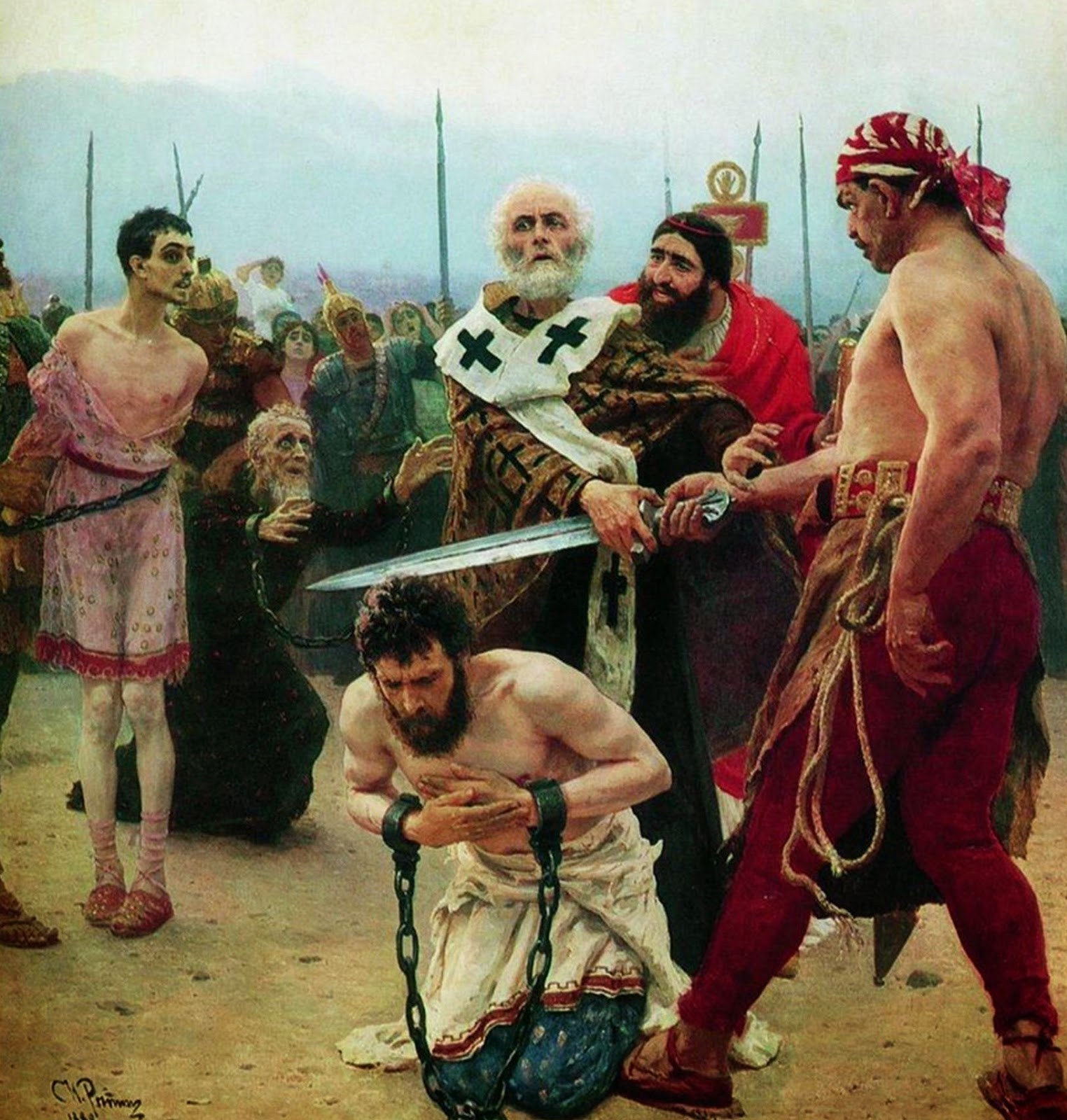
Николай Мирликийский избавляет от смерти трёх невинно осуждённых. Image: Ilya Repin · Public domain · Wikimedia Commons, accessed 2026-08-04
The Peredvizhniki, known in English as the Wanderers or the Itinerants, were a coalition of Russian realist painters who formed the Society for Traveling Art Exhibitions in 1870, growing out of the 1863 Revolt of the Fourteen, when a group of graduating students at the St. Petersburg Imperial Academy of Arts refused to paint the assigned mythological competition subject and left to form an independent artists' cooperative. That cooperative later evolved into the Peredvizhniki proper.
Visually, the group favored sober realist technique in service of genre scenes of peasant life, social criticism, portraiture, and historical subjects reconsidered through a humanist, often critical lens, alongside Russian landscape painting invested with national and emotional feeling. Their work rebelled against the Academy's insistence on classical, mythological, and biblical subjects removed from Russian life, its rigid hierarchy privileging history painting above all else, and its general detachment from contemporary social reality, a detachment increasingly out of step with the utilitarian aesthetics championed by critics like Vladimir Stasov and writers like Nikolai Chernyshevsky, who argued art should serve society directly.
The movement matters because it shaped a new canon of specifically Russian subject matter, peasants, provincial towns, forests, and historical figures reinterpreted critically, and pioneered the idea of touring exhibitions that carried finished paintings beyond the capital to reach ordinary provincial audiences. It produced towering figures, Ilya Repin, Vasily Surikov, and Isaac Levitan among them, still central to Russian national identity in art. Their exhibitions typically opened in St. Petersburg or Moscow before touring for months through provincial centers, exposing regional audiences to serious contemporary painting for the first time. The movement's populist ethos was later selectively co-opted as an ancestor of Socialist Realism under Soviet cultural policy, though its actual practice was far more varied, psychologically nuanced, and painterly than that later official doctrine.
What defines Peredvizhniki
Unvarnished peasant and provincial genre scenes
The Wanderers painted rural labor, poverty, and everyday provincial life without the sentimental polish common in earlier genre painting. The aim was social truth rather than picturesque rustic charm.
Critical historical painting
History paintings reinterpreted episodes of Russian history, often ones involving state violence or resistance, as a way of commenting obliquely on contemporary politics under a censored press.
Psychologically direct portraiture
Portraits of writers, scientists, and public figures favored sober realism and inner presence over academic flattery, producing some of the era's most enduring images of Russian cultural figures.
The mood landscape
Isaac Levitan developed a landscape approach, later called the mood landscape, that used weather, season, and light to project emotional and even spiritual states rather than simply document scenery.
Earthy, restrained palette
Muted umbers, ochres, and greens replaced the brighter decorative color of academic and Salon painting, reinforcing the group's commitment to sober, unidealized truth-telling.
Independent traveling exhibitions
Rather than exhibiting only through the Imperial Academy in St. Petersburg, the group organized its own touring shows that carried finished paintings to provincial cities across the Russian Empire, reaching audiences the Academy never addressed.
History
The movement's origin lies in the 1863 Revolt of the Fourteen: fourteen students, led by Ivan Kramskoi, refused the Academy's assigned mythological theme for the Gold Medal competition and walked out, forming the St. Petersburg Artel of Artists, a cooperative studio and exhibition society. In 1870, several of these artists and other realist-minded painters founded the Society for Traveling Art Exhibitions, formalizing the Peredvizhniki. The society organized annual exhibitions that toured provincial Russian cities, Moscow, Kiev, Kharkiv, and beyond, bringing contemporary art to audiences with no access to the St. Petersburg or Moscow academies and salons.
Key members included Ivan Kramskoi, an organizing and theoretical leader, Ilya Repin, Vasily Surikov, Ivan Shishkin, and Isaac Levitan. The critic Vladimir Stasov championed the group publicly, and the collector Pavel Tretyakov, whose collection became the Tretyakov Gallery, was their most important patron, purchasing extensively from their exhibitions. The group's peak influence ran through the 1870s to 1890s.
By the turn of the century, younger artists were drawn to newer currents, Symbolism, the World of Art group led by figures around Sergei Diaghilev, and eventually the Russian avant-garde, and the Peredvizhniki's realist program came to seem conservative by comparison. The society formally continued into the early 20th century, but its cultural centrality had faded well before the Russian Revolution of 1917. After 1917, Soviet cultural authorities retrospectively championed the Peredvizhniki as populist forerunners of officially sanctioned Socialist Realism, a legacy that both preserved their reputation through the Soviet period and flattened the actual range of their work into simpler propaganda terms.
Key works
| Work | Artist | Year | Why it matters |
|---|---|---|---|
| Barge Haulers on the Volga | Ilya Repin | 1873 | A landmark of Russian realism depicting exhausted laborers hauling a barge, widely read as social commentary on inequality. |
| Ivan the Terrible and His Son Ivan on 16 November 1581 | Ilya Repin | 1885 | A psychologically intense history painting reinterpreting a moment of royal violence and grief rather than glorifying state power. |
| Boyarynya Morozova | Vasily Surikov | 1887 | A large-scale historical scene depicting a defiant religious dissenter, treating Russian history as a story of individual conscience against authority. |
| Above Eternal Peace | Isaac Levitan | 1894 | A defining example of Levitan's mood landscape, using a vast, somber sky over a small church to evoke spiritual contemplation. |
| Morning in a Pine Forest | Ivan Shishkin | 1889 | A meticulously observed forest scene, its bears painted by fellow artist Konstantin Savitsky, that became one of the era's most widely reproduced images. |
How to make art in this style
Subject matter. Draw from directly observed, unglamorized life, labor, domestic scenes, provincial streets, or a landscape charged with mood rather than picturesque prettiness. Historical subjects work well when reinterpreted with a critical, human eye rather than triumphant pageantry.
Palette. Stay earthy and restrained, umbers, ochres, olive greens, and muted greys, rather than bright decorative color. Let color reinforce mood and season rather than surface appeal.
Composition. Ground the scene in a believable, detailed environment with a clear focal figure or group. Consider a wide format that lets the environment, a muddy road, a bare rural yard, a cramped interior, carry as much narrative weight as the human subject itself. Portraits should aim for psychological presence: a direct, unflattering gaze and careful attention to the sitter's actual features rather than idealization.
Technique. Apply solid academic draftsmanship in service of truth-telling rather than polish, visible but controlled brushwork, close attention to the texture of skin, worn cloth, and weathered wood. For landscape, treat light, season, and weather as expressive tools, an overcast sky, bare branches, or a low winter sun can carry as much emotional weight as any figure. Work from direct observation wherever possible, and resist the impulse to soften or beautify a difficult subject.
Legacy
The Peredvizhniki established a canon of specifically Russian subject matter, peasant life, provincial towns, national history, and emotionally charged landscape, that became foundational to Russian art-historical identity, anchored by the collection Pavel Tretyakov built largely from their exhibitions and later gave to the nation as the Tretyakov Gallery.
Their populist model, carrying serious art directly to provincial audiences outside the capital, anticipated later Soviet cultural policy. After 1917, Soviet authorities championed the Peredvizhniki retrospectively as forerunners of Socialist Realism, a framing that preserved their reputation through the Soviet period but flattened the real variety of their painterly and psychological achievement into simpler propagandistic terms.
Levitan's mood landscapes shaped generations of later Russian landscape painters, and Repin's psychological realism remains a reference point for figurative painting in Russia. International museums and scholars have shown renewed interest in the group in recent decades, part of a broader reassessment of 19th-century art produced outside the traditional Western European canon of Paris, London, and Rome.
Frequently asked questions
What does Peredvizhniki mean?
Peredvizhniki translates roughly as the Wanderers or the Itinerants, referring to the traveling exhibitions the group organized to bring art to Russian provincial cities outside St. Petersburg and Moscow.
What was the Revolt of the Fourteen?
In 1863, fourteen students at the Imperial Academy of Arts in St. Petersburg, led by Ivan Kramskoi, refused to paint the assigned mythological subject for their graduation competition and left to form an independent artists' cooperative, a precursor to the Peredvizhniki.
Peredvizhniki vs Socialist Realism, what's the difference?
The Peredvizhniki were an independent 19th-century realist movement with a genuine range of subjects and psychological depth, while Socialist Realism was an official Soviet doctrine imposed from 1932 onward. Soviet authorities later cast the Peredvizhniki as forerunners of Socialist Realism, but the comparison simplifies the earlier group's actual variety.
Who funded the Peredvizhniki's exhibitions?
The collector Pavel Tretyakov was their most important patron, purchasing extensively from their touring shows; his collection later became the basis of Moscow's Tretyakov Gallery.
Who were the leading Peredvizhniki painters?
Ilya Repin and Vasily Surikov are the group's best-known figures, alongside landscape painter Isaac Levitan, forest painter Ivan Shishkin, and the organizing figure Ivan Kramskoi.