 Art
Art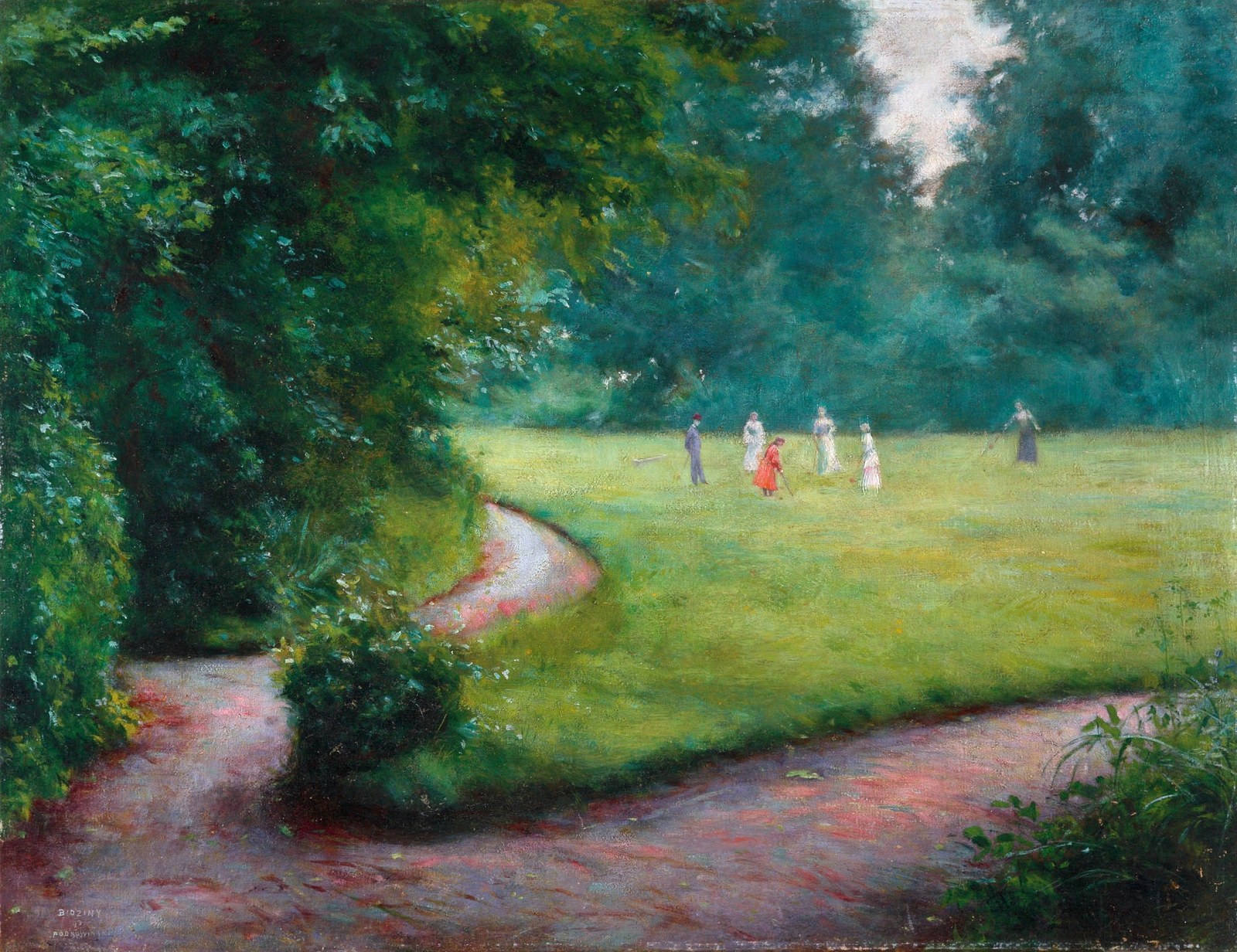
Polish: Gra w krokieta (fragment parku w Bidzinach koło Sandomierza). Image: Władysław Podkowiński · Public domain · Wikimedia Commons, accessed 2026-08-04
Impressionism began in Paris in the 1860s and 1870s as a group of independent-minded painters turned away from the polished, mythological, or historical subjects favored by the official Salon and toward the fleeting, ordinary world in front of them: train stations, cafes, ballet rehearsals, riverbanks, and gardens under specific, changing light. Named, mockingly at first, after Claude Monet's 1872 painting Impression, Sunrise, the movement made the act of perception itself the subject of painting, capturing how a haystack or a cathedral facade looked at a particular hour rather than how it was supposed to look in ideal form.
Visually, Impressionist canvases are built from short, visible brushstrokes of pure, often unmixed color, placed side by side so the eye blends them at a distance. Painters worked outdoors, en plein air, made possible by the newly available portable paint tubes, chasing changing light and weather rather than composing from memory in a studio. Compositions often felt cropped or asymmetrical, borrowing the casual framing of photography and the flattened perspective of Japanese woodblock prints, both newly fashionable in Paris at the time.
The movement rebelled against the French Academy's rigid hierarchy of subject matter, which ranked historical and religious painting above landscape and everyday scenes, and against its demand for smooth, invisible brushwork and finished, idealized surfaces. Rejected repeatedly from the official Salon, the Impressionists organized their own independent exhibitions beginning in 1874, a radical act of self-determination for artists at the time.
Impressionism matters because it redefined what painting could be about, the transient, the modern, the personally observed, and how it could look, loose, spontaneous, and openly process-revealing. It effectively launched modern art's long move away from illusionistic realism toward paintings that acknowledge their own surface and making. Its embrace of everyday middle-class leisure, boating parties, dance halls, department stores, also captured a newly industrializing, newly urban France in a way academic painting never had.
What defines Impressionism
Broken, visible brushwork
Paint was applied in short, distinct dabs and strokes rather than blended into smooth transitions. Up close the canvas can look almost abstract; from a distance the strokes resolve into shimmering light and form.
Painting outdoors, en plein air
Artists worked directly in front of their subjects, often finishing canvases outside rather than in the studio, chasing specific and changing conditions of weather and time of day.
Pure, unmixed color and optical mixing
Rather than pre-mixing colors on a palette, painters placed complementary and contrasting hues side by side, letting the eye blend them, which produced brighter, more vibrant surfaces than traditional glazing techniques.
Everyday, contemporary subject matter
Ballet dancers, cafe-concerts, train stations, riverside boating, and suburban gardens replaced history painting and mythology, reflecting the leisure and spectacle of modern urban and bourgeois life.
Interest in transient light and atmosphere
Several Impressionists painted the same subject repeatedly under different light, most famously Monet's series of haystacks, poplars, and Rouen Cathedral, treating light itself as the true subject.
Cropped, asymmetrical composition
Compositions often echoed snapshot photography and Japanese prints, with figures cut off at the frame's edge, high or tilted viewpoints, and off-center focal points.
History
Impressionism grew out of the loose circle of painters, Claude Monet, Pierre-Auguste Renoir, Alfred Sisley, and Frédéric Bazille, who met in the studio of Charles Gleyre in the early 1860s; Camille Pissarro and Edgar Degas joined the circle around the same period. They were influenced by the outdoor naturalism of the earlier Barbizon School and by Realist painters like Gustave Courbet and Édouard Manet, whose Déjeuner sur l'herbe was rejected by the 1863 Salon jury and caused a scandal at the Salon des Refusés with its blunt modern subject and loose handling. Manet became an important, if reluctant, figurehead for the younger group.
Repeatedly rejected by the official Salon jury, the artists organized an independent exhibition in April 1874 at photographer Nadar's former studio. A hostile critic, seizing on Monet's Impression, Sunrise, coined "Impressionists" as an insult; the group adopted the name. Seven more group exhibitions followed through 1886, though the participants and their styles diverged considerably over that time. Women artists, notably Berthe Morisot and the American-born Mary Cassatt, were core members, exhibiting alongside their male colleagues and bringing scenes of domestic and family life into the movement's subject range.
Through the late 1870s and 1880s, Impressionism gained dealers, notably Paul Durand-Ruel, and gradually found buyers, particularly in the United States, where American collectors and later American painters embraced the style. By the mid-1880s, however, the original group was fragmenting: Renoir turned toward a firmer, more classical figure style; Pissarro experimented briefly with the stricter pointillist technique of the younger Neo-Impressionists; Degas increasingly worked in pastel. Monet continued alone longest, pursuing ever more radical series paintings of water lilies into the twentieth century.
By 1890, Impressionism had become broadly accepted and commercially successful, and its innovations, plein air practice, broken color, everyday subject matter, had already opened the door to the more radical experiments of Post-Impressionism.
Key works
| Work | Artist | Year | Why it matters |
|---|---|---|---|
| Impression, Sunrise | Claude Monet | 1872 | The painting that gave the movement its name, depicting Le Havre harbor at dawn in loose, atmospheric strokes. |
| Bal du moulin de la Galette | Pierre-Auguste Renoir | 1876 | A large, crowded scene of Sunday dancing in Montmartre, celebrated for its dappled light falling through trees onto the crowd. |
| The Cradle | Berthe Morisot | 1872 | An intimate domestic scene showing the movement's engagement with private, everyday family life alongside its public leisure scenes. |
| Boulevard Montmartre series | Camille Pissarro | 1897 | A series of Parisian street views painted from a hotel window, capturing changing light and weather over a bustling boulevard. |
| The Dance Class | Edgar Degas | 1874 | A behind-the-scenes view of a Paris ballet rehearsal, typical of Degas's interest in unposed, off-balance movement and cropped framing. |
| Water Lilies (series) | Claude Monet | 1906 | Part of Monet's decades-long series of his Giverny garden pond, pushing color and brushwork toward near-abstraction. |
How to make art in this style
Palette. Use bright, relatively unmixed colors, cobalt and ultramarine blue, viridian, cadmium yellow, rose and crimson, with color used to suggest light and atmosphere rather than local object color. Avoid heavy black; shadows should be built from blues, violets, and complementary colors rather than gray or black mixtures.
Composition. Work from direct observation where possible, and let the composition feel caught rather than staged: crop figures at the frame's edge, use an elevated or informal viewpoint, and avoid perfectly centered, symmetrical arrangements. Choose transient, everyday subjects, gardens, water, café scenes, figures in motion, over posed or historical ones.
Brushwork. Apply paint in short, distinct strokes or dabs rather than smooth blending, letting individual marks of color sit next to each other so they mix optically at a viewing distance rather than physically on the palette. Work quickly and directly, building the painting in one or a few sessions to preserve spontaneity, and resist the urge to overwork or smooth the surface.
Light and atmosphere. Treat changing light as a primary subject: note how the same scene shifts with time of day, season, or weather, and consider working in a short series to study those changes. Keep values relatively close and let color temperature, not just tonal contrast, do the work of describing form and depth.
Subjects. Favor modern, observed life: parks, rivers, harbors, cafes, dancers, domestic interiors. Painting outdoors, if practical, sharpens the direct observation of light that defines the style; working from photographs or memory tends to pull the result back toward studio smoothness.
Legacy
Impressionism is arguably the single most influential movement in the emergence of modern art, opening the path for Post-Impressionism, Fauvism, and ultimately abstraction by legitimizing visible brushwork, subjective color, and everyday subject matter as serious artistic territory rather than unfinished sketchwork. Painters as different as Van Gogh, Cézanne, and Matisse all began from Impressionist premises before pushing past them.
Beyond painting, Impressionism reshaped popular taste and visual culture broadly. Its images of gardens, riverbanks, cafes, and dappled light became, and remain, the most reproduced and commercially beloved paintings in Western art, appearing on everything from calendars to museum gift shop merchandise, sometimes at the cost of obscuring how radical the work was in its own time. The movement also helped establish the modern art market structure, independent dealers, solo gallery shows, art criticism as promotion, that continues to shape how contemporary art is sold today.
Its technical innovations, painting outdoors, working in series, using color to suggest light rather than local hue, remain foundational training in art schools. Contemporary plein air painting movements explicitly trace their lineage to the Impressionists, and the loose, gestural mark-making pioneered here underlies much of how casual, expressive painting is still taught and practiced.
Frequently asked questions
What is Impressionism?
Impressionism is a painting movement that began in Paris in the 1860s and 1870s, characterized by visible brushstrokes, bright unmixed color, everyday modern subject matter, and an interest in capturing fleeting light and atmosphere, often painted outdoors.
Who started Impressionism?
Claude Monet, Pierre-Auguste Renoir, Camille Pissarro, Edgar Degas, Alfred Sisley, and Berthe Morisot were the core founding figures, meeting in Paris in the 1860s and organizing the first independent group exhibition in 1874.
Why is it called Impressionism?
The name comes from Claude Monet's 1872 painting Impression, Sunrise. A hostile critic reviewing the group's 1874 exhibition used the term mockingly to suggest the works looked unfinished, and the artists adopted it themselves.
What is the difference between Impressionism and Post-Impressionism?
Impressionism focused on capturing fleeting light and visual sensation through loose, direct brushwork. Post-Impressionists like Cézanne, Van Gogh, and Gauguin, working slightly later, kept bright color but pushed toward more structured composition, personal symbolism, and expressive distortion rather than pure optical observation.
What techniques define Impressionist painting?
Short visible brushstrokes, painting outdoors directly from the subject, pure colors placed side by side rather than premixed, and an emphasis on capturing a specific moment of light rather than an idealized, timeless image.
Where did Impressionism take place?
It originated in Paris, France, centered on independent exhibitions held between 1874 and 1886, though its painters worked throughout the French countryside, particularly along the Seine and in Normandy.