 Art
Art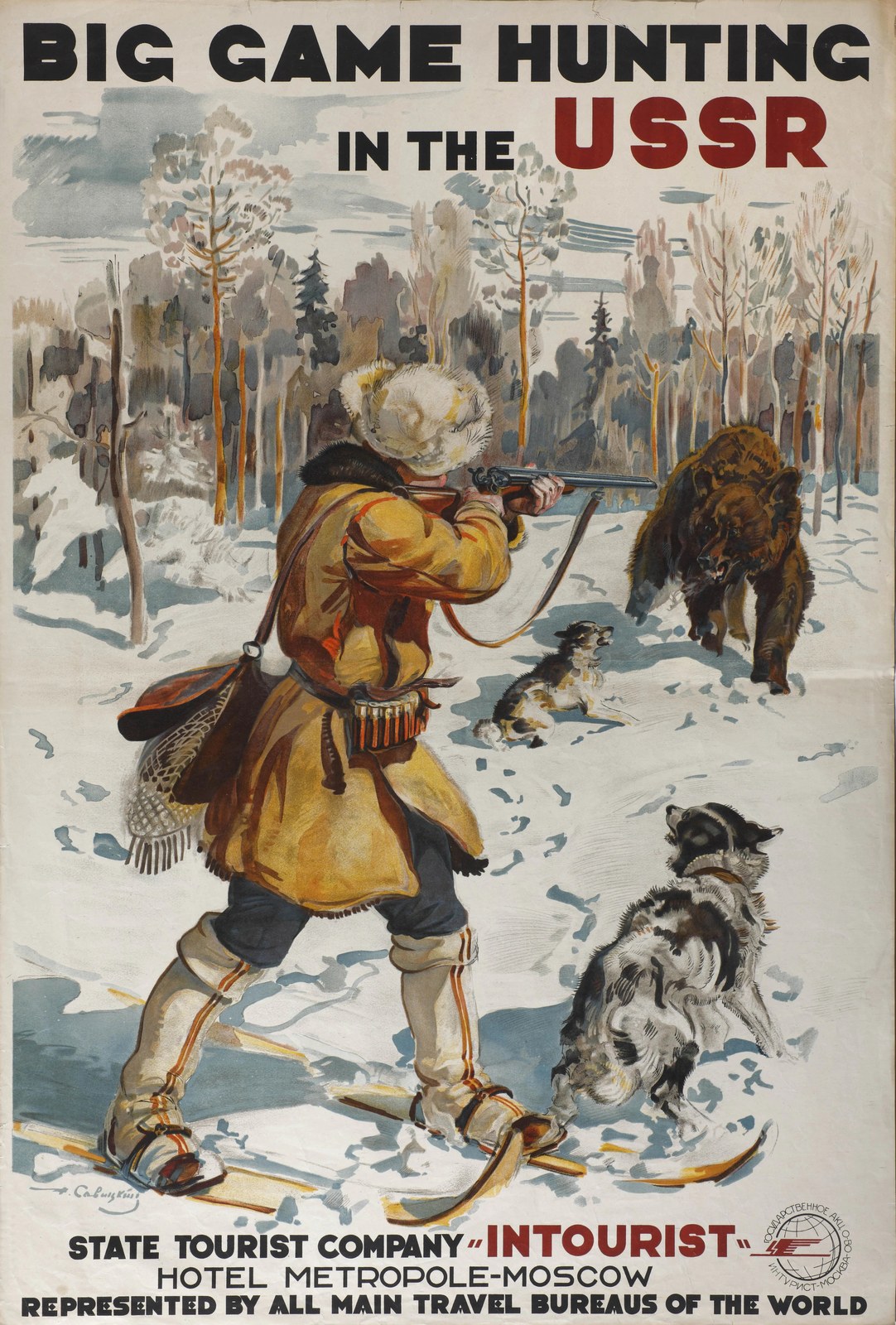
Big Game Hunting in the USSR. Image: Georgi Konstantinowitsch Sawizki · Public domain · Wikimedia Commons, accessed 2026-08-04
Socialist Realism was the officially mandated artistic doctrine of the Soviet Union, formally established in 1934 and enforced across Soviet visual art, literature, and film for decades afterward. Its guiding formula, that art should be "national in form, socialist in content," required artists to work in a clear, accessible, realistic style depicting the achievements and ideals of Communism: heroic laborers, triumphant soldiers, collective farmers, and idealized portraits of Party leaders, above all Lenin and Stalin.
The doctrine emerged directly out of a 1932 Communist Party decree that dissolved independent artistic organizations and consolidated all Soviet artists under state-controlled unions. In doing so, it forcibly suppressed the extraordinary avant-garde experimentation of the preceding decade, Russian Constructivism and Suprematism among them, which the Party judged too abstract and inaccessible for a mass proletarian audience. Painters such as Isaak Brodsky, known for his reverent portraits of Lenin, and Alexander Deineka, who depicted athletic Soviet labor and youth with dynamic energy, became leading exemplars of the new style. Sculptor Vera Mukhina created Worker and Kolkhoz Woman, a monumental stainless-steel sculpture that became one of the twentieth century's most recognizable Soviet images.
Socialist Realism differs fundamentally from American Social Realism, which shares part of its name. Where Social Realism critiqued real conditions of poverty and injustice, Socialist Realism functioned as state propaganda, presenting an idealized vision of Communist achievement rather than documenting hardship. Deviation from the mandated style carried real professional and, at the height of Stalinist repression, personal risk.
The style spread beyond the Soviet Union to other Communist states after World War II, including China, Eastern Europe, and North Korea, each developing local inflections of the same core visual formula. Socialist Realism matters both as one of history's clearest examples of state-controlled art in service of political power, and as the deliberate, forceful termination of one of the twentieth century's most innovative avant-garde movements, a loss still mourned by art historians.
What defines Socialist Realism
Heroic, idealized figures
Workers, soldiers, and collective farmers were rendered as muscular, dignified, and monumental, embodying Communist ideals of labor and collective strength rather than individual likeness.
Highly legible academic-realist technique
The style demanded smooth, accessible finish and clear narrative content, explicitly rejecting abstraction or ambiguity as elitist and incomprehensible to a mass audience.
Optimistic, propagandistic content
Subjects celebrated industrial and agricultural achievement, military victory, and Communist Party leadership, presenting an idealized present or future rather than critiquing actual conditions.
Monumental public scale
Painting, sculpture, and murals were produced at large, imposing scale intended for mass public display in state buildings, public squares, and exhibitions.
Dynamic, forward-thrusting composition
Bright, often theatrical lighting and diagonal, forward-moving compositions conveyed a sense of progress, momentum, and historical inevitability.
Reverent leader portraiture
Lenin, Stalin, and other Party leaders were depicted as noble, paternal, or visionary figures, a distinct and heavily regulated genre within the broader style.
History
Socialist Realism followed a period, the 1920s, in which the Soviet Union had embraced radical avant-garde experimentation, Constructivism and Suprematism among them, as the visual language of revolution. By the early 1930s, the Communist Party under Stalin had come to view this abstraction as elitist and incomprehensible to ordinary workers. The Party's 1932 decree "On the Reconstruction of Literary and Artistic Organizations" dissolved independent artistic groups, and the doctrine of Socialist Realism was formally proclaimed at the 1934 First All-Union Congress of Soviet Writers, with Maxim Gorky and Party cultural official Andrei Zhdanov among its key architects, before being extended across painting and sculpture through the state-controlled Union of Soviet Artists.
Isaak Brodsky became a leading painter of reverent Lenin portraits and revolutionary historical scenes. Alexander Deineka depicted athletic, heroic Soviet labor, sport, and youth with dynamic, modern energy. Vera Mukhina created Worker and Kolkhoz Woman in 1937, a monumental stainless-steel sculpture originally made for the Paris International Exposition and later installed as a permanent Moscow landmark.
The style was mandatory and enforced through state-controlled unions, exhibitions, and commissions; artists who deviated risked professional exclusion and, during the worst periods of Stalinist repression, far graver consequences. After World War II, Socialist Realism spread to Communist allies, including China, Eastern Europe, and North Korea, each adapting the formula to local political needs.
Following Stalin's death in 1953 and the subsequent political "Thaw" under Khrushchev, the doctrine's rigidity gradually loosened, and by the 1960s and 1970s underground alternative movements, including Moscow Conceptualism and the ironic Sots Art movement, which directly parodied Socialist Realism's imagery, developed in defiance of official style. Socialist Realism remained the Soviet Union's nominal official art doctrine until its 1991 collapse, though its dominance had weakened considerably in the preceding decades.
Key works
| Work | Artist | Year | Why it matters |
|---|---|---|---|
| Worker and Kolkhoz Woman | Vera Mukhina | 1937 | A monumental stainless-steel sculpture of a striding male worker and female collective farmer, among the most recognizable Soviet artistic images. |
| Lenin in the Smolny | Isaak Brodsky | 1930 | An iconic, reverent portrait depicting Lenin in quiet contemplation, exemplifying the style's approach to leader portraiture. |
| The Defense of Petrograd | Alexander Deineka | 1928 | A dynamic, rhythmically composed depiction of armed civilian defenders, an early work anticipating the mature Socialist Realist style. |
| Future Pilots | Alexander Deineka | 1938 | An idealized painting of boys gazing at seaplanes, embodying Soviet themes of youth, technological optimism, and national aspiration. |
How to make art in this style
This style is documented here for its historical visual technique and as a case study in state-controlled propaganda art, not as a model to emulate uncritically; approach its heroic idiom with historical awareness of the political system that mandated it.
Palette. Use bold primary reds paired with warm golds, alongside industrial grays and blues for machinery or military settings. Lighting is typically bright and theatrical rather than naturalistic, reinforcing an atmosphere of optimism and triumph.
Composition. Favor a low, heroic viewing angle that monumentalizes the central figure, combined with dynamic diagonal composition suggesting forward motion, progress, or triumph. Multiple figures are often arranged to suggest collective unity and shared purpose rather than individual isolation.
Technique. Work in a smooth, highly finished academic-realist manner, idealizing musculature, posture, and facial expression rather than recording individual likeness with documentary accuracy. Avoid any abstraction, distortion, or ambiguity; legibility and clear narrative content were the style's non-negotiable requirements.
Subjects. Depict industrial or agricultural labor, collective achievement, military victory, or youthful optimism, with figures shown in confident, upward, or forward-striving poses. Leader portraiture, when included, should convey calm authority and visionary purpose rather than individual psychology.
Context. Understanding this style requires understanding its function: it was not a personal artistic choice but a state-enforced doctrine, and its heroic optimism was frequently at odds with the harsher realities of the society it depicted.
Legacy
Socialist Realism shaped the visual identity of twentieth-century Communist states and remains a central case study in the history of state-controlled art and propaganda. Its monumental, heroic visual vocabulary has since been deliberately reappropriated and parodied, most notably by the Sots Art movement of the 1970s and 1980s, whose artists ironically recycled Socialist Realist imagery to critique the ideology it once served.
The style continues to inform how later artists and designers approach propaganda aesthetics and political kitsch, and its imagery is frequently referenced, often critically, in contemporary art addressing state power and historical memory. Vera Mukhina's Worker and Kolkhoz Woman remains one of the most widely recognized sculptural images to emerge from the Soviet period.
Equally significant is Socialist Realism's role in the deliberate suppression of the preceding Russian avant-garde, an artistic loss still mourned by historians and one that fuels ongoing scholarly and curatorial interest in reviving and reassessing Constructivism and Suprematism. Socialist Realism endures, above all, as the clearest twentieth-century example of art conscripted directly into the service of state ideology, a reference point in continuing debates over art's relationship to political power.
Frequently asked questions
What is Socialist Realism?
Socialist Realism was the official, state-mandated art style of the Soviet Union from 1934 onward, requiring idealized, accessible depictions of workers, soldiers, and Communist Party leaders in service of state ideology.
What is the difference between Socialist Realism and Social Realism?
Socialist Realism was Soviet state propaganda glorifying an idealized Communist present. Social Realism, largely American, was independent, often critical art documenting real poverty and injustice, with no state mandate behind it.
Who established Socialist Realism as doctrine?
The Soviet Communist Party's 1932 decree dissolved independent artistic organizations, and the doctrine was formally proclaimed at the 1934 First All-Union Congress of Soviet Writers before being extended to painting and sculpture.
Did Socialist Realism end with the Soviet Union?
It remained the nominal official style until the USSR's 1991 collapse, though its grip loosened considerably after Stalin's death in 1953, as underground alternative movements developed in the following decades.