 Art
Art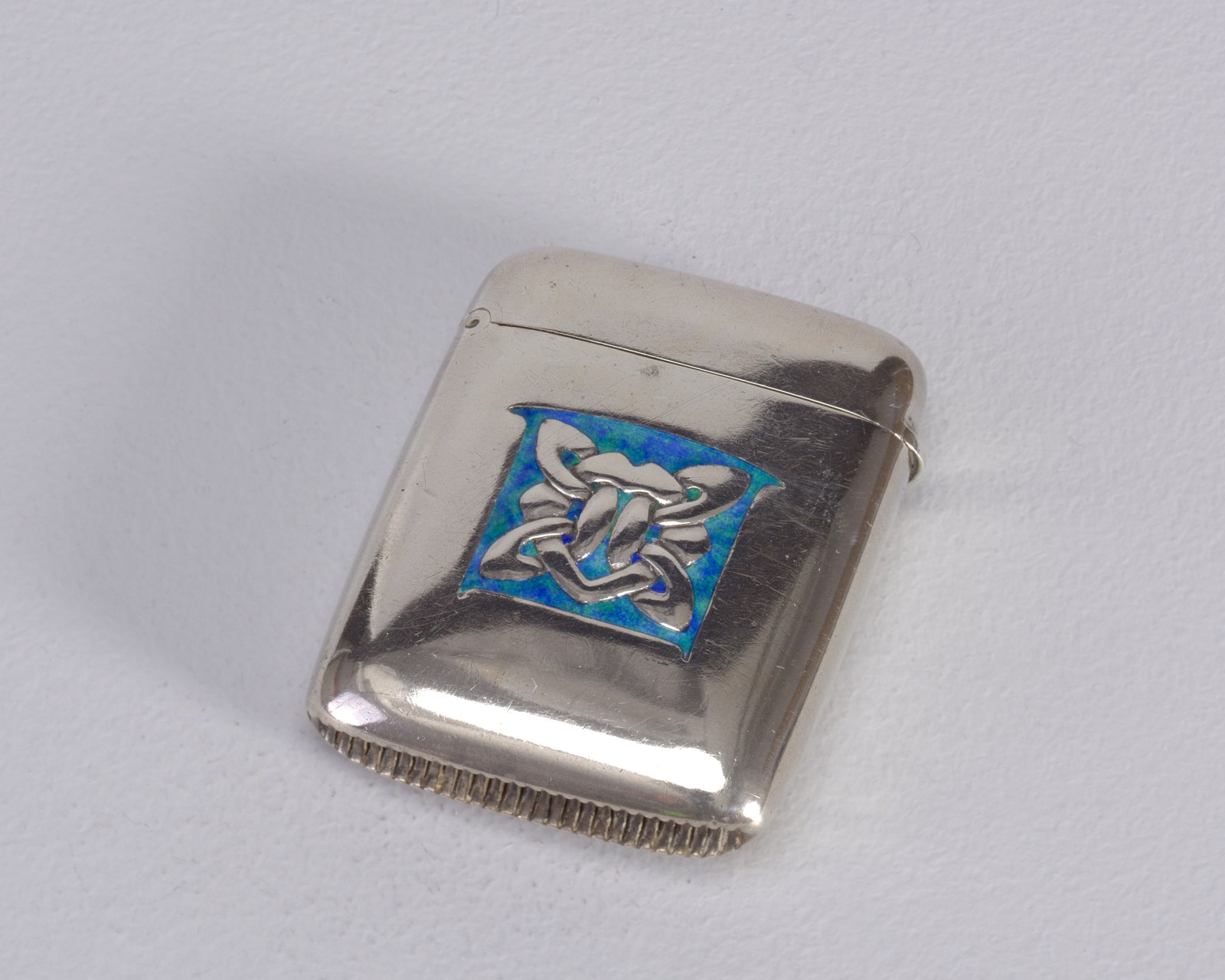
Arts and Crafts Style with Celtic Knot Matchsafe, 1902–03. Image: Unknown artistUnknown artist · Public domain · Wikimedia Commons, accessed 2026-08-04
The Arts and Crafts Movement emerged in England in the 1860s as a direct response to the Industrial Revolution's flood of cheap, machine-stamped goods. Led in spirit by the critic John Ruskin and put into practice by the designer William Morris, it argued that mass production had severed the bond between maker and object, producing furniture, wallpaper, and buildings that were ugly, dishonest about their materials, and degrading to the workers who made them. In their place, the movement proposed a return to handcraft: objects made by skilled individuals working with natural materials, following medieval guild traditions of pride in labor.
Visually, Arts and Crafts work favored flat, stylized patterns drawn from plants and birds, rich but earthy colors, and visible construction — exposed joinery in furniture, hand-thrown irregularities in ceramics, hand-set type and woodblock illustration in books. Morris's wallpapers and textiles, produced through his firm Morris & Co., became the movement's most recognizable output, their dense interlacing florals rejecting both Victorian clutter and machine repetition. Architecture followed the same logic: the Red House, built by Philip Webb for Morris in 1859, used local red brick and steep gables instead of borrowed classical or Gothic facades, aiming for a building honest about its structure and setting.
The movement rebelled against both industrial capitalism's factory conditions and the eclectic historicism of Victorian taste, which recycled ornament from past styles without regard for function or material. Morris tied his design philosophy to socialist politics, believing that beautiful, well-made objects and dignified labor were inseparable — a conviction that gave the movement a moral urgency beyond aesthetics.
Arts and Crafts matters because it was the first coherent modern argument that how something is made shapes its meaning, an idea that echoes through twentieth-century design reform, the studio craft movement, and today's renewed interest in handmade, small-batch, and sustainably produced goods. It also produced, through Kelmscott Press and the Guild of Handicraft, some of the era's most beautifully unified objects, where typography, illustration, binding, and paper were all conceived as one.
What defines Arts and Crafts Movement
Stylized natural pattern
Wallpapers and textiles used flattened, repeating motifs of leaves, birds, and flowers rather than illusionistic depth. Morris's designs interlace foliage into dense, all-over surfaces that read as pattern first and nature second.
Visible, honest craftsmanship
Joints, hinges, and hand-tooling were left exposed rather than disguised, signaling that an object was made by a person's hand and not stamped from a machine. Irregularities were treated as proof of authenticity, not flaws to be hidden.
Natural, unadorned materials
Oak, copper, wool, and unbleached linen were preferred in their natural state or with simple finishes, avoiding the veneers, gilding, and imitation materials common in Victorian manufacture.
Medievalist and folk sources
Designers drew on Gothic architecture, medieval manuscripts, and English vernacular building traditions, treating the pre-industrial guild workshop as a model for organizing labor and training.
Unity of the arts
A single project, house, book, or interior, was conceived as one designed whole, with architecture, furniture, textiles, and typography brought into visual harmony rather than assembled from mismatched styles.
Earthy, muted color
Palettes leaned toward deep greens, russets, ochres, and indigo, colors associated with natural dyes and traditional pigments rather than the brighter synthetic dyes newly available to industry.
History
The movement's intellectual roots lie in the writings of John Ruskin, whose 1850s essays condemned industrial labor as dehumanizing and held up medieval craftsmanship as a moral ideal. William Morris, who had trained as an architect and was close to the Pre-Raphaelite painters, turned Ruskin's ideas into practice. In 1861 he founded a decorative arts firm, later Morris & Co., producing wallpaper, textiles, stained glass, and furniture designed for hand production. His own house, the Red House of 1859-60, designed with architect Philip Webb, became an early manifesto in brick and timber.
Through the 1870s and 1880s the movement organized itself formally: the Century Guild, the Art Workers' Guild, and the Arts and Crafts Exhibition Society, which gave the movement its name in 1887. Morris's Kelmscott Press, founded in 1891, extended the philosophy to book design, producing hand-set, hand-illustrated volumes like the 1896 Kelmscott Chaucer. Designers including Walter Crane, C.F.A. Voysey, and Charles Robert Ashbee, whose Guild of Handicraft trained craftsmen in metalwork and jewelry, spread the aesthetic across furniture, silver, and architecture.
The ideas crossed the Atlantic quickly. In the United States, Gustav Stickley's Craftsman furniture and magazine, Elbert Hubbard's Roycroft workshops, and the architecture of Greene and Greene adapted the philosophy to American materials and markets, producing the sturdy, exposed-joint furniture now generally called Mission style. The movement also influenced Scotland's Charles Rennie Mackintosh and fed into the emerging Art Nouveau across Europe.
By the 1910s, the movement's central contradiction, handmade goods priced for wealthy buyers while claiming to dignify ordinary labor, had become difficult to sustain, and its aesthetic ideas were increasingly absorbed into Art Nouveau and, later, into modernist design reform movements like the Deutscher Werkbund and the Bauhaus.
Key works
| Work | Artist | Year | Why it matters |
|---|---|---|---|
| Red House | Philip Webb and William Morris | 1860 | Morris's own home, an early architectural manifesto rejecting historicist facades for honest brick construction. |
| Trellis (wallpaper) | William Morris | 1862 | One of Morris's first wallpaper designs, establishing the dense, flattened floral pattern language the firm became known for. |
| Strawberry Thief (textile) | William Morris | 1883 | A widely reproduced indigo-discharge printed fabric, among the most recognizable Arts and Crafts patterns ever made. |
| Kelmscott Chaucer | William Morris, illustrations by Edward Burne-Jones | 1896 | A hand-printed edition of Chaucer treating typography, illustration, and binding as one unified design object. |
| Gamble House | Greene and Greene | 1908 | A California residence often cited as the high point of American Arts and Crafts architecture, with hand-joined woodwork throughout. |
How to make art in this style
Palette. Work with a restrained, earthy range: deep forest and olive green, terracotta or rust, ochre and mustard yellow, walnut brown, and a warm off-white or cream ground. Avoid bright synthetic-looking hues; every color should feel plausible as a natural dye or mineral pigment.
Composition. Think in terms of flat, all-over pattern rather than illusionistic depth. For textile or wallpaper-style work, build a repeating unit, a stem, leaf cluster, or bird motif, and let it interlace across the surface so the eye can't easily find a beginning or end. For furniture or object design, let the visible structure, joints, hinges, rivets, become part of the composition rather than something to conceal.
Technique. Favor woodblock printing, linocut, or hand-drawn line work over painterly blending; the Arts and Crafts look depends on crisp, deliberate edges and consistent line weight, closer to a printmaker's economy than a painter's atmosphere. If working digitally, simulate the texture of hand-block printing: slight registration imperfections, flat color fills, and visible outline.
Subjects. Draw motifs from the immediate natural world: garden flowers, birds, vines, oak leaves, acorns, thistles. Stylize rather than render naturalistically, flattening forms into decorative shapes that repeat cleanly. For interiors or architectural renderings, emphasize local materials and vernacular building forms, gabled roofs, exposed timber, hand-thrown tile, over historical borrowed grandeur.
Overall approach. Treat every element of a design, pattern, frame, lettering, as part of one unified scheme rather than separate decisions, and let visible evidence of the hand, an irregular line, a deliberate asymmetry, remain in the finished work.
Legacy
Arts and Crafts reshaped how designers thought about the relationship between object, maker, and material, an argument that outlived the movement's own workshops. Its insistence on structural honesty and material integrity fed directly into Art Nouveau and, more surprisingly, into the industrial modernism of the Deutscher Werkbund and the Bauhaus, which kept the emphasis on function and craft training while embracing the machine production Morris had rejected. In the United States, its furniture vocabulary survives as the Mission and Craftsman styles, still manufactured and widely imitated in home decor today.
The movement also established the modern idea of the studio craftsperson, an artist working in clay, wood, metal, or fiber as a fine artist rather than an anonymous tradesperson, a model that underlies contemporary studio pottery, furniture-making, and textile art. Its magazines and guild structures were early templates for design education, influencing art school curricula well into the twentieth century.
Its visual language persists everywhere in interior design: exposed beams, built-in cabinetry, hand-thrown ceramics, and botanical wallpaper patterns all trace back to Arts and Crafts workshops. The contemporary maker movement, with its emphasis on local, small-batch, and handmade goods sold as an alternative to mass manufacture, echoes Morris's original argument almost exactly, even if few buyers today know the movement's name.
Frequently asked questions
What is the Arts and Crafts Movement?
It was a design reform movement that began in England around 1860, promoting handcraftsmanship, natural materials, and medieval guild ideals as an alternative to industrial mass production. Its leading figure was William Morris, who applied the philosophy to wallpaper, textiles, furniture, and books.
Who started the Arts and Crafts Movement?
William Morris is generally credited as its central founder and practitioner, building on the earlier critical writings of John Ruskin. Morris's firm, Morris & Co., and later his Kelmscott Press, became the movement's most influential workshops.
What did the Arts and Crafts Movement rebel against?
It rebelled against industrial mass production and the cheap, ornamentally excessive goods of Victorian manufacturing, as well as the poor working conditions of factory labor. It sought to restore dignity to craftsmanship by returning to hand production.
How did the Arts and Crafts Movement spread to America?
American designers and publishers, including Gustav Stickley and Elbert Hubbard, adapted the philosophy in the 1890s and 1900s, producing what became known as Mission or Craftsman style furniture and architecture, exemplified by firms like Greene and Greene.
What is the difference between Arts and Crafts and Art Nouveau?
Arts and Crafts emphasized handcraft, honest structure, and often geometric or restrained pattern rooted in medieval and folk sources. Art Nouveau, which it influenced, pursued more sinuous, whiplash organic curves and was more willing to use new industrial materials like cast iron and glass.