 Art
Art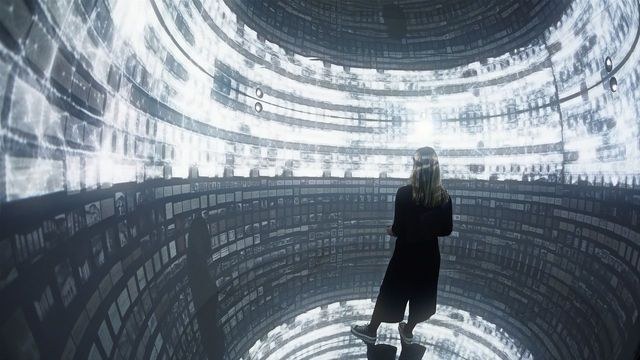
Archive Dreaming by Refik Anadol. Image: Refik Anadol · CC BY-SA 4.0 · Wikimedia Commons, accessed 2026-08-04
AI Art refers to images, video, and installations created with the assistance of machine learning systems—computer programs trained on large datasets of existing images that learn statistical patterns of color, form, and composition well enough to generate new visual output, often from a written text description. Unlike earlier computer-generated art, which typically relied on explicit rules and algorithms written directly by the artist, AI art systems learn their visual behavior from data, making the artist's role often closer to selecting, prompting, training, and curating than manually rendering each mark.
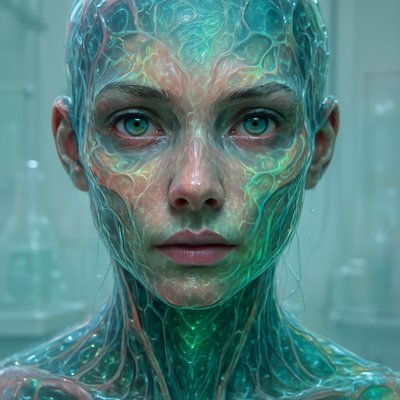
Visually, AI art spans an enormous range, from the dreamlike, morphing distortions typical of early neural-network image-generation techniques, to the highly polished, photorealistic or stylized imagery produced by more recent text-to-image systems, to large-scale immersive data-visualization installations that translate vast datasets into shifting projected imagery. Early work in the field often displayed telltale artifacts of the underlying technology—warped forms, dreamlike recursive patterns, uncanny blends of unrelated subjects—that have become less pronounced as the technology has matured.
The field's technical roots lie in machine learning research: the development of generative adversarial networks, or GANs, in 2014, and Google's "DeepDream" project in 2015, which revealed and amplified patterns a trained image-recognition network "saw" in existing photographs, are widely regarded as pivotal early demonstrations that neural networks could generate rather than merely classify images. Artists quickly began adapting these research tools for expressive purposes through the later 2010s, and later text-to-image diffusion models beginning around 2022 made the technology accessible to a vastly larger, non-technical audience.
AI Art has generated significant debate, in ways few prior movements have, over questions of authorship (who is the artist—the person prompting the system, or the system itself), originality (since models are trained on existing images, often without the original creators' consent), and labor (concerns from working artists about displacement and uncompensated use of their work in training data). It matters because it represents perhaps the most consequential and disruptive technological shift in image-making since the invention of photography, forcing legal systems, museums, and the art market to rapidly reconsider foundational assumptions about what authorship and creativity mean.
What defines AI Art
Machine-Learning-Generated Imagery
Images are produced by neural networks trained on large datasets, generating new visual output based on learned statistical patterns rather than being drawn or painted stroke by stroke by a human hand.
Prompt and Parameter as Authorial Tool
The artist's primary creative input is often a written description, a set of chosen parameters, or curated training data, shifting the artist's role toward direction, selection, and curation rather than direct manual execution.
Dreamlike Distortion in Early Work
Early neural-network-generated imagery frequently displayed characteristic artifacts—melting or recursive patterns, warped anatomy, uncanny hybrid forms—that became a recognizable visual signature of the technology's early limitations.
Rapid Technical Evolution
The field's visual capabilities have changed dramatically within a short span, moving from abstract, painterly distortions in the mid-2010s to highly detailed, photorealistic output by the early 2020s, making it one of the fastest-evolving visual styles in art history.
Scale and Iteration
Because generation is comparatively fast once a system is trained, artists frequently work through large numbers of variations, selecting and refining favored results, an iterative workflow with few precedents in traditional art-making.
Data and Dataset as Subject
Some of the field's most discussed work makes the underlying training data and machine 'hallucination' itself the visible subject, translating enormous datasets into visual or immersive form rather than concealing the generative process.
History
AI Art's technical foundations reach back to early computer art and algorithmic experiments of the mid-20th century, but the specific machine-learning approaches that define the current field emerged from artificial intelligence research in the 2010s. Google's "DeepDream" project, released publicly in 2015, took an existing image-recognition neural network and ran it in reverse, amplifying patterns the network had learned to recognize and producing surreal, hallucinatory imagery that quickly circulated online and drew significant public and artistic attention. The concept of generative adversarial networks, or GANs, introduced by researcher Ian Goodfellow and colleagues in 2014, gave artists a more flexible tool for training systems to generate novel, convincing images from a dataset.
Through the mid-to-late 2010s, artists including Mario Klingemann built dedicated practices using GANs and related techniques, producing generative portraiture and installation work; his piece "Memories of Passersby I" (2018), a live-generating GAN housed in a custom wooden cabinet, sold at Sotheby's in 2019, an early signal of institutional market interest. In 2018, the French collective Obvious sold "Portrait of Edmond de Belamy," a GAN-generated portrait, at Christie's for $432,500—widely reported as the first AI-generated artwork sold at a major auction house, and a moment that provoked substantial debate within the AI art community over authorship credit and technical originality.
The field transformed dramatically beginning around 2021 and 2022 with the public release of increasingly capable text-to-image diffusion models, which allowed anyone to generate detailed images from a written prompt without technical training. This shift moved AI art from a specialized practice into a mass creative activity almost overnight, while simultaneously intensifying legal and ethical disputes over training data, copyright, and consent that continue largely unresolved. Major artists working at institutional scale, including Refik Anadol with large-scale data-driven installations, brought AI-generated visual work into prominent museum settings through the early 2020s, and the field remains in active, rapid development today.
Key works
| Work | Artist | Year | Why it matters |
|---|---|---|---|
| Portrait of Edmond de Belamy | Obvious | 2018 | A GAN-generated portrait sold at Christie's for $432,500, widely reported as the first AI-generated artwork sold at a major auction house. |
| Memories of Passersby I | Mario Klingemann | 2018 | A live-generating GAN installation housed in a custom wooden cabinet that continuously produces new portraits, sold at Sotheby's in 2019. |
| Neural Zoo | Sofia Crespo | 2018 | A project generating imagined biological creatures from neural networks trained on natural-history imagery, blending AI art with bio-inspired form. |
| Unsupervised | Refik Anadol | 2022 | A large-scale data-trained AI installation shown at the Museum of Modern Art, translating the museum's own collection data into shifting generative imagery. |
How to make art in this style
Working in an AI Art Style Today
Understand your role. In AI art, the human's contribution typically centers on direction and curation—writing and refining prompts, choosing training data, selecting among generated variations, and editing or combining outputs—rather than manual mark-making. Treat this curatorial and editorial work as the actual craft to develop.
Prompt and parameter craft. Effective prompting is a skill built through iteration: write specific, concrete language describing subject, lighting, palette, composition, and mood, then refine based on results rather than expecting a single attempt to succeed. Keep records of which language choices produce results you find successful, building a personal vocabulary over time.
Palette and composition through selection. Since generation typically produces many variations, develop a strong personal eye for editing—selecting, cropping, and sequencing among results the way a photographer selects from a contact sheet, rather than treating the first output as finished.
Post-processing. Manual editing, color correction, compositing, and combining multiple generated elements are standard parts of a serious practice, not a departure from it; many of the field's most acclaimed works involve substantial post-generation editing and assembly, including combining outputs into large-scale installations.
Data and training awareness. If training or fine-tuning a custom model, think carefully about the source and rights status of training material, since dataset ethics and consent are among the field's most actively contested issues.
Subjects. Common territory includes exploring the technology's own visual signatures—morphing, hybrid forms—large-scale data visualization, portraiture, and self-aware commentary on machine perception, authorship, and the boundary between human and machine creativity.
Legacy
AI Art's central legacy is still actively being written, but its impact on image-making has already been profound: it lowered the technical barrier to generating detailed visual imagery to nearly zero, fundamentally changing who can produce images and how quickly. It forced overdue legal and ethical scrutiny of how training datasets are assembled, reigniting debate across the entire creative industry about consent, compensation, and copyright that extends well beyond art into photography, illustration, writing, and design.
Institutionally, the field pushed major auction houses and museums to engage seriously, if cautiously, with machine-generated work, following high-profile sales like Christie's 2018 auction of "Portrait of Edmond de Belamy" and Sotheby's 2019 sale of Klingemann's GAN installation. Large-scale, data-driven AI installations by artists such as Refik Anadol have brought the technology into major museum spaces at architectural scale, demonstrating one direction the field has matured toward beyond single generated images.
Its influence on broader visual culture is already immense: AI-generated imagery now appears throughout advertising, publishing, entertainment, and social media, and the movement's core debates—about authorship, originality, labor, and consent—are actively reshaping copyright law and professional practice across the entire creative economy, not just fine art.
Frequently asked questions
What is AI Art?
AI Art is imagery, video, or installation work created with the assistance of machine learning systems—neural networks trained on large datasets that generate new visual output, often from a text prompt. The artist's role typically shifts toward prompting, curating, training, and editing rather than direct manual rendering.
Who started AI Art?
There is no single founder; the field grew from AI research through the 2010s, with early artistic milestones including Google's 2015 "DeepDream" project and the development of generative adversarial networks in 2014. Artists such as Mario Klingemann and the collective Obvious were among the first to bring the technology into gallery and auction contexts in the late 2010s.
When did AI Art become widely known?
Public and market attention grew significantly in 2018, when Christie's sold the GAN-generated "Portrait of Edmond de Belamy" for $432,500, and expanded dramatically from 2022 onward with the public release of accessible text-to-image generation tools.
Is AI Art copyrighted or original?
This remains a genuinely unsettled legal and ethical question. Debates center on whether AI-generated images can hold copyright, whether training on existing artists' work without consent constitutes infringement, and how much human authorship a given piece actually reflects—questions still being actively litigated and debated.
AI Art vs Crypto Art—how do they relate?
They are related but distinct: Crypto Art concerns how digital art is owned and sold, via blockchain, while AI Art concerns how the imagery itself is produced, via machine learning. The two fields overlap significantly, since AI-generated work is frequently sold as NFTs.