 Art
Art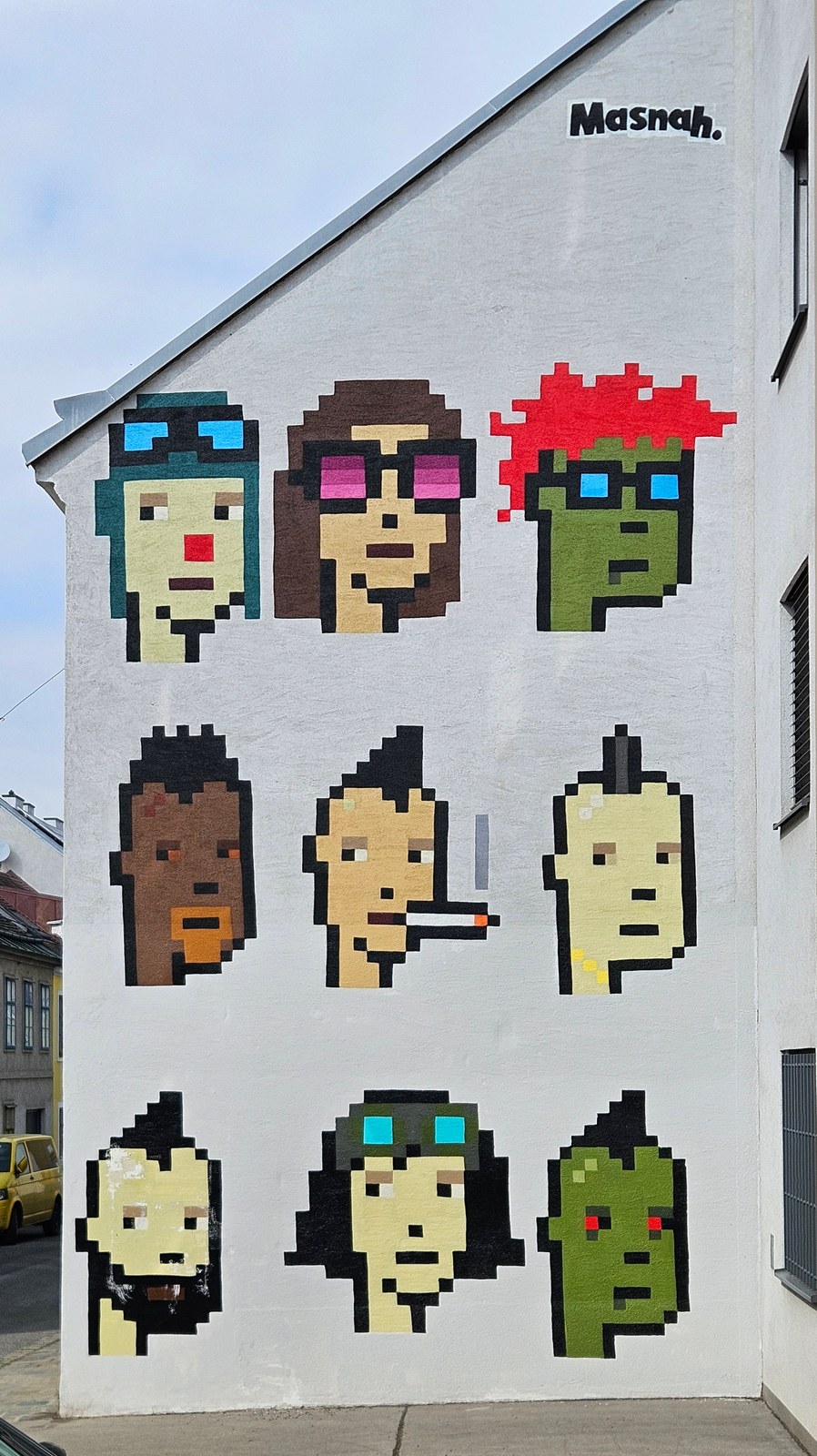
Cryptopunks. Image: Matthias Weiss 2026 · CC0 · Wikimedia Commons, accessed 2026-08-04
Crypto Art is digital artwork whose ownership, authenticity, and sale are recorded on a blockchain, typically in the form of a non-fungible token, or NFT—a unique cryptographic record proving that a specific buyer holds the "original" of an otherwise infinitely copyable digital file. The art itself can look like almost anything—pixel-art characters, glitch animations, generative code art, digital collage, 3D renders—since crypto art describes a system of ownership and market infrastructure rather than a single visual style.
What crypto art added to digital art was scarcity. Before blockchain-based ownership, a digital image could be copied infinitely with no meaningful distinction between "original" and copy, which made collecting and selling purely digital work difficult. NFTs solved this by creating a unique, verifiable, and tradable token linked to a specific file or its metadata, recorded permanently on a public ledger. This let digital-native artists sell work the way physical artists sell paintings—as unique or limited-edition objects with traceable provenance and resale value.
The scene began in 2017 with early blockchain-based projects: CryptoPunks, a set of 10,000 algorithmically generated pixel-art characters released by Larva Labs, and CryptoKitties, a blockchain-based collectible game, demonstrated that unique digital assets could be owned and traded on-chain. A dedicated crypto art market grew through platforms built specifically for NFT sales, and by 2020 and 2021 the field had attracted a growing base of digital-native artists and collectors, many operating entirely outside the traditional gallery system.
Crypto art reached mainstream attention in March 2021, when Christie's auction house sold Beeple's "Everydays: The First 5000 Days" for $69.3 million, the first purely digital, NFT-linked artwork sold by a major traditional auction house. The sale triggered a wider boom, with prices, media coverage, and new entrants surging through 2021 before a significant market contraction in subsequent years.
Crypto art rebelled against the traditional gatekeeping structure of the fine-art world—galleries, dealers, museums—by letting artists mint, sell, and profit from resale royalties on work directly to a global collector base without institutional intermediaries. It matters because it forced a rapid, public reckoning with what digital ownership means, and its boom-and-bust trajectory remains a significant case study in how markets, speculation, and new technology can reshape an art field almost overnight.
What defines Crypto Art
Blockchain-Verified Ownership
Each work is tied to a unique token recorded on a public blockchain ledger, providing a permanent, verifiable record of who owns the piece and its full transaction history, something conventional digital files cannot offer.
Digital-Native Visual Styles
Common visual modes include algorithmically generated pixel-art characters, looping glitch animation, generative code-based patterns, and digital collage—styles that read clearly on screens and translate well to small thumbnail marketplace displays.
Collectible, Series-Based Structure
Work is frequently released in large generative series, often 10,000 pieces, with randomized combinations of traits, borrowing directly from collectible-card culture rather than the single unique masterpiece model of traditional fine art.
Market-Driven, Platform-Native Distribution
Sales happen primarily through dedicated online marketplaces and auction platforms rather than physical galleries, with pricing, resale, and community activity playing out publicly and in real time.
Glitch, Pixel, and Screen Aesthetics
Visual references to early computing, video game graphics, and digital corruption—glitch artifacts, low-resolution pixel grids, scan-line textures—recur throughout the field, evoking internet and gaming culture rather than fine-art painting traditions.
Volatility and Speculation
Because value is tied directly to a fast-moving, often speculative market, crypto art has been marked by dramatic price swings, making the movement as notable for its economic history as for any single consistent visual style.
History
Crypto Art's technical foundation is the blockchain, a distributed public ledger first popularized by Bitcoin in 2009 and made more flexible for arbitrary digital assets by Ethereum in 2015, whose smart-contract capability allowed developers to create unique, tradable tokens. In 2017, two pivotal projects demonstrated the concept for art and collectibles: CryptoPunks, 10,000 algorithmically generated pixel-art characters released by Larva Labs, and CryptoKitties, a blockchain game built around breeding unique digital cats, which became popular enough to noticeably slow the Ethereum network.
Through 2018 and 2019, a smaller community of digital-native artists—including XCOPY, known for dystopian, glitch-styled animated work—began minting and selling art as NFTs on early dedicated marketplaces, building a market largely outside traditional gallery and auction-house attention. Interest accelerated through 2020 as NFT platforms matured and a broader collector base, drawn partly from cryptocurrency communities, began entering the market.
The field's watershed moment came in March 2021, when Christie's sold Beeple's "Everydays: The First 5000 Days"—a collage of 5,000 daily digital images made over more than thirteen years—for $69.3 million, making it one of the most valuable artworks ever sold by a living artist at auction and instantly legitimizing crypto art in the eyes of the mainstream art market. A broader boom followed through 2021, including Pak's "The Merge," a mass-participation NFT sale that aggregated to a reported $91.8 million, among the era's most valuable single art sales by total value.
The market contracted significantly from 2022 onward, with NFT trading volumes and prices falling sharply amid broader cryptocurrency market declines, prompting widespread debate about the field's long-term viability. Crypto art continues today as a smaller, more specialized market than at its 2021 peak, having neither fully collapsed nor sustained its boom-era scale, with its techniques and community increasingly overlapping with AI art.
Key works
| Work | Artist | Year | Why it matters |
|---|---|---|---|
| CryptoPunks | Larva Labs | 2017 | A set of 10,000 algorithmically generated pixel-art characters, widely regarded as one of the first NFT collections and a foundational reference point for the field. |
| Everydays: The First 5000 Days | Beeple | 2021 | A composite of 5,000 daily images sold at Christie's for $69.3 million, the sale that brought crypto art to mainstream attention. |
| The Merge | Pak | 2021 | A mass-participation NFT sale that aggregated to a reported $91.8 million across tens of thousands of collectors, one of the era's largest single art sales by value. |
How to make art in this style
Creating in a Crypto Art Style Today
Understand it's a system, not just a look. Crypto art is defined as much by blockchain-based ownership and distribution as by any single visual style, so working "in" this style today generally means both making digitally native imagery and considering how it would be minted, verified, and sold—even if you never actually mint a token.
Visual language. Draw on the field's core aesthetics: crisp pixel-art grids and limited color palettes reminiscent of early video games, glitch artifacts and digital corruption, generative and algorithmically combined character traits, and clean, bold outlines that read clearly even at small thumbnail size on a marketplace listing.
Palette. High-contrast, saturated color—neon greens, magentas, cyans—paired with dark backgrounds works well, echoing both glitch-art traditions and the screen-lit, nighttime browsing context where much crypto art is actually viewed and traded.
Composition and format. Favor square or simple rectangular formats designed to work as small profile-picture-style thumbnails as well as larger displayed images; many successful pieces in this space were designed with both contexts in mind from the start.
Series thinking. Consider working in sets with systematic, combinable variations—different color schemes, accessories, backgrounds—rather than a single unique image, following the generative collection model that has defined much of the field's most recognized work.
Subjects. Common territory includes digital identity and avatars, critique or celebration of internet and crypto culture itself, dystopian or cyberpunk imagery, and self-aware commentary on ownership, value, and speculation.
Legacy
Crypto Art's most consequential legacy is technical and economic rather than purely stylistic: it demonstrated, for the first time at real scale, that purely digital files could carry verifiable scarcity and provenance, solving a problem—infinite, indistinguishable copying—that had limited the digital art market for decades. This reshaped how digital-native artists could sell and profit from resale of their work, including built-in resale royalty mechanisms that gave artists an ongoing stake in secondary sales, a structure largely unavailable in the traditional art market.
Its 2021 boom, headlined by Beeple's record-breaking Christie's sale, forced traditional auction houses, galleries, and museums to seriously engage with digital-native art and artists many had previously ignored, and brought a new, often younger and more online, collector base into contact with the broader art world. Even after the market's contraction from its peak, the underlying infrastructure—blockchain-verified ownership of digital assets—continues to be explored across digital art generally, including by AI artists selling generative work as authenticated editions. Crypto art also stands as a widely studied case of how quickly speculation, media attention, and genuine artistic activity can become entangled in a fast-moving market, a dynamic likely to recur as new technologies enter the art world.
Frequently asked questions
What is Crypto Art?
Crypto Art refers to digital artwork bought, sold, and authenticated using blockchain technology, typically minted as non-fungible tokens (NFTs), which provide a unique, verifiable record of ownership for an otherwise freely copyable digital file.
What is an NFT and how does it relate to Crypto Art?
An NFT, or non-fungible token, is a unique digital record stored on a blockchain that certifies ownership of a specific asset. Most crypto art is sold as NFTs, which is why the terms "crypto art" and "NFT art" are often used interchangeably.
When did Crypto Art become mainstream?
The field reached mainstream attention in March 2021, when Christie's auction house sold Beeple's "Everydays: The First 5000 Days" for $69.3 million, triggering a broader market boom through the rest of that year.
Who are notable Crypto Art figures?
Beeple became the field's most publicly recognized artist after his record-breaking 2021 Christie's sale. Other prominent figures include the pseudonymous artists Pak and XCOPY, and Larva Labs, the studio behind the pioneering CryptoPunks collection.
Is Crypto Art still active today?
The market contracted significantly after its 2021 peak, with trading volumes and prices falling, but crypto art continues as an active, if smaller and more specialized, field, with ongoing overlap with AI-generated art.